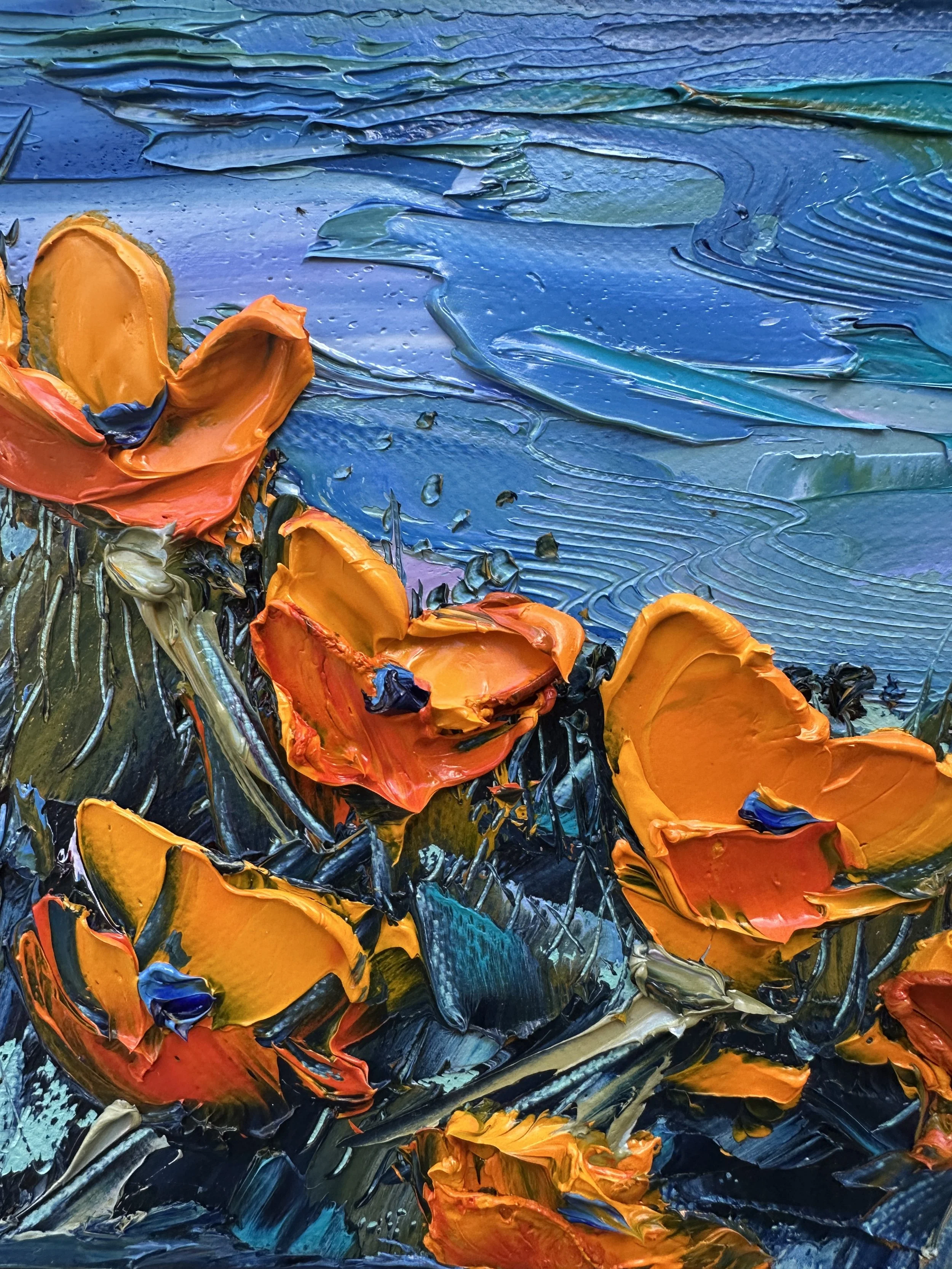
When a Chapter Finishes Quietly
There’s a particular kind of moment that comes after long relationships end.
It’s not the ending itself.
That part is usually clear, sometimes painful, sometimes necessary, often both.
This moment comes later.
It arrives when you realize your ex has moved on.
Not as information.
As sensation.
By the time this happens, you may already be stable.
You may already trust yourself.
You may already know the relationship ended for good reasons.
And still, the body responds.
That doesn’t mean anything is unresolved.
It means something is completing.
When you share decades with someone, your nervous system adapts to shared orientation. Even after separation, some part of the body still remembers how it once organized around “we.”
When that final thread releases, it can feel hollow. Or tender. Or strangely neutral.
This isn’t grief the way we usually talk about grief.
It’s not longing.
It’s not regret.
It’s the body acknowledging that a structure it once relied on no longer exists.
And that moment can be surprisingly emotional, not because you want to go back, but because something real just finished.
There’s often a quiet strength that follows.
A grounded sense of:
I know how to hold myself now.
Not as independence for show.
As embodied security.
This is the part of the journey that doesn’t get celebrated.
There are no milestones.
No announcements.
No clear next step.
Just presence.
And presence is enough.
You don’t need to analyze this phase.
You don’t need to optimize it.
You don’t need to move through it faster.
Let the nervous system complete what the mind already understands.
Completion is gentle.
Completion is quiet.
Completion doesn’t rush.
And when it settles, what remains is not emptiness, but ground.
You’re standing on it now.
If this reflection resonated, I’ve gathered a small private library of long-form audio reflections called Lumera, created for slower integration, nervous-system steadiness, and living through transitions without pressure.
You can explore it quietly, if and when it feels right, at https://windsweptstudio.com/lumera
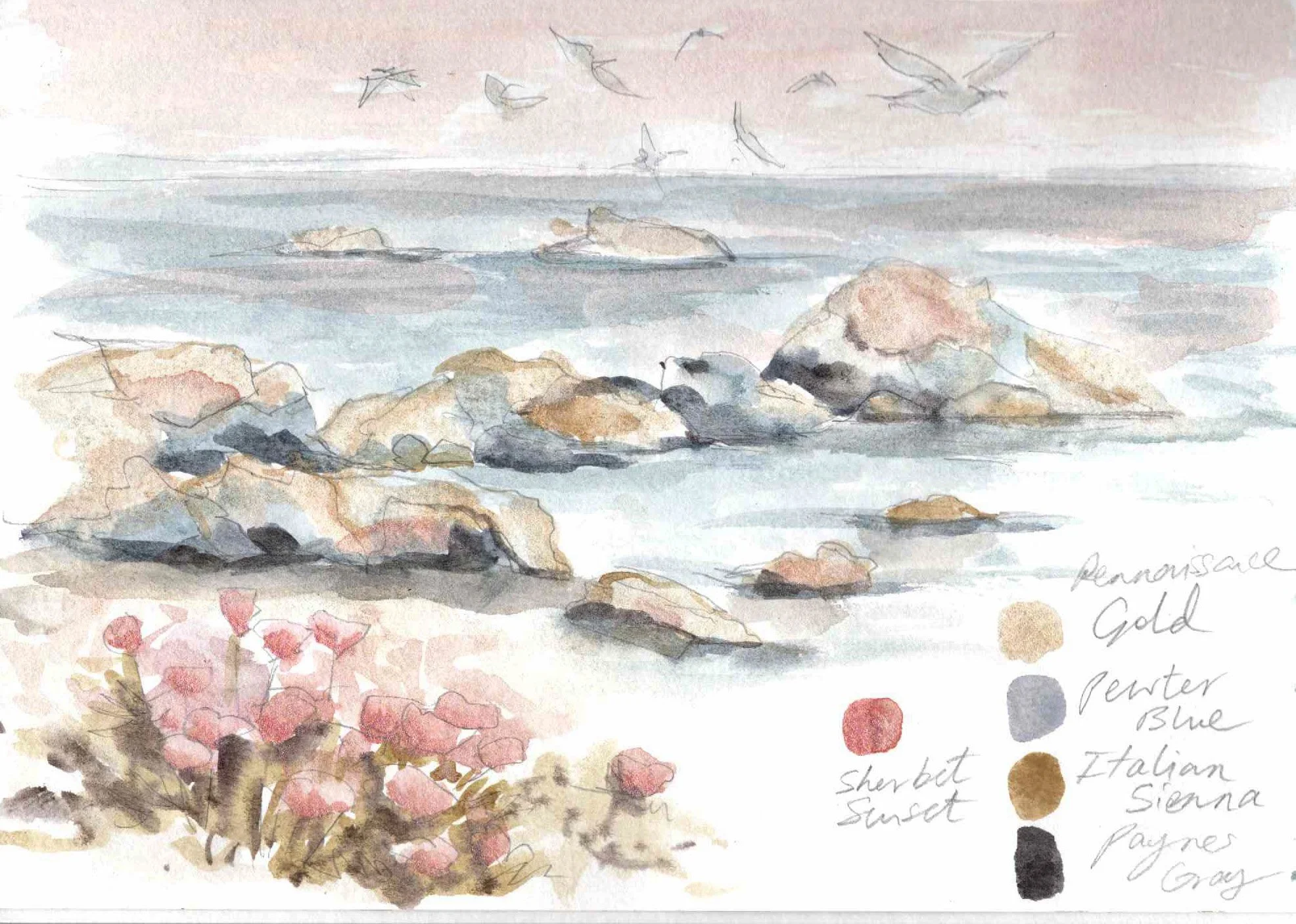
Twelve Years of Trust: A Reflection on My Journey with UGallery
Longevity is one of the rarest currencies in the art world.
Trends move quickly. Platforms change. Attention shifts.
What lasts, truly lasts, is built on trust, patience, and the willingness to grow together over time.
This week, UGallery published a feature interview about my work, my process, my history, and the way texture and landscape have shaped my artistic language.
You can read the full article here:
👉 https://www.ugallery.com/blogs/artist-interviews/lisa-elley
As I read it, what struck me most wasn’t seeing my own words reflected back, it was realizing how rare a 12-year partnership truly is in the art world.
UGallery and I began working together over a decade ago, long before social media algorithms, constant content cycles, or overnight success stories became the norm. Over the years, my life has changed in real ways, raising children, relocating studios, evolving my work, weathering economic shifts, and continuing to show up to the canvas day after day.
Through all of it, this partnership has remained steady.
That kind of longevity doesn’t come from hype.
It comes from trust.
Trust in the work.
Trust in the artist’s evolution.
Trust that a career can be built slowly, honestly, and with integrity.
The interview touches on many parts of my process, my palette-knife technique, my love of California landscapes, my travels, and the way texture has become my primary language. But what is subtext, is the quiet, unglamorous consistency behind the scenes.
The thousands of hours alone in the studio.
The seasons of refinement.
The willingness to let the work mature alongside the person making it.
That’s what a long partnership holds space for.
I’m deeply grateful to UGallery for continuing to support artists not just at a moment in time, but across the arc of a career. Being featured after twelve years doesn’t feel like a peak, it feels like a marker of continuity.
And continuity, in a creative life, is everything.
If you’d like to browse my exclusively represented portfolio on Ugallery, tap the link below
👉 https://www.ugallery.com/pages/lisa-elley
Lisa
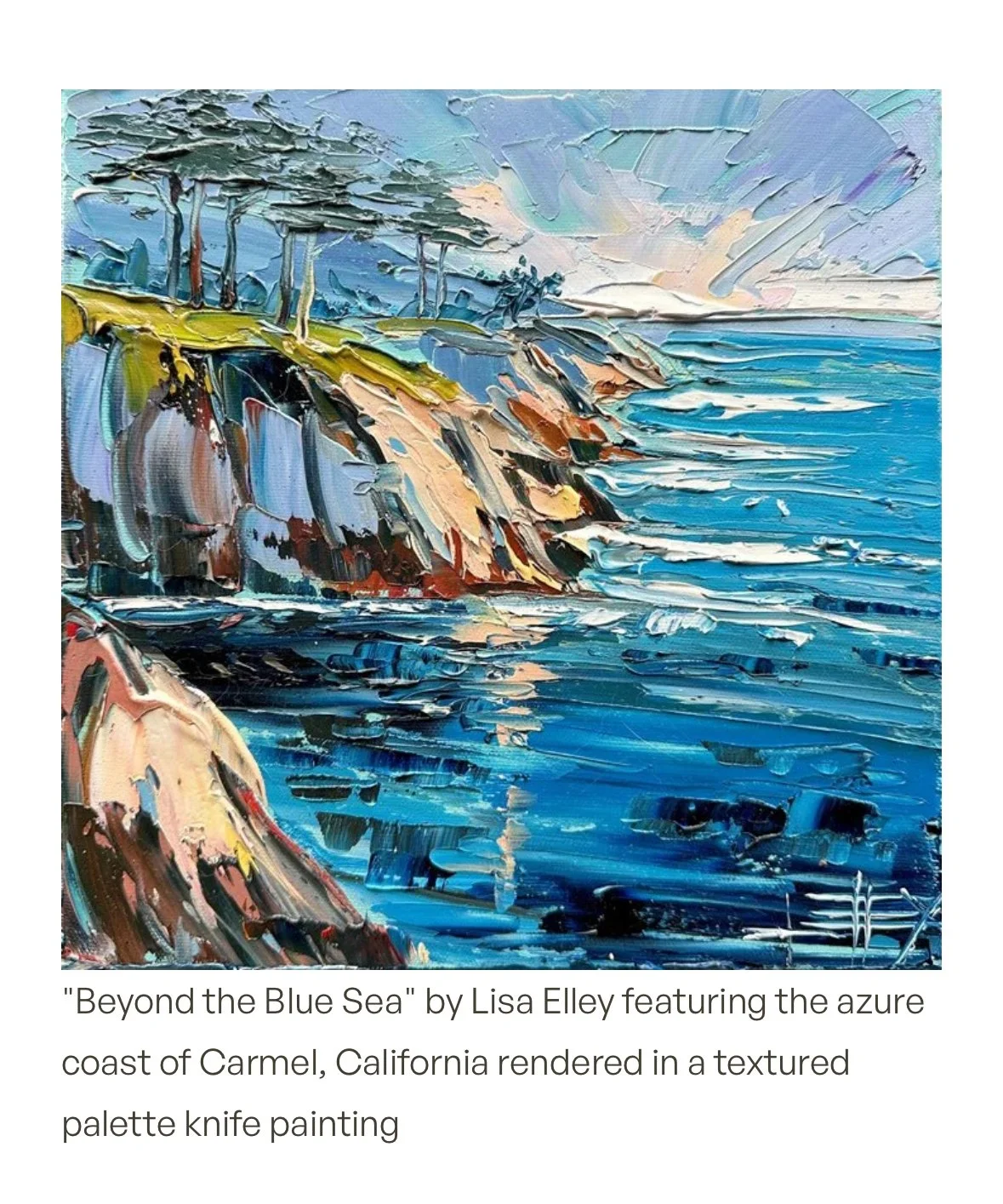
The Moment You Realize It Was Never Apathy, It Was Your Nervous System
There’s a quiet turning point in a person’s inner life, a moment you rarely see coming and often don’t have words for.
It’s the moment you realize that so much of what you once interpreted as distance, disinterest, or emotional apathy…
was not the truth of the situation at all.
It was your nervous system doing what it learned to do.
When you’ve lived years, or decades, in a body that had to anticipate, manage, or soften the emotional landscape around you, your system becomes skilled at reading micro-cues.
It becomes attuned to danger, not connection.
To inconsistencies, not steadiness.
To what went wrong then, instead of what’s actually happening now.
So later in life, when you meet someone grounded and neutral, your system can easily misread that energy as “something is wrong.”
Neutrality can feel like distance.
Slowness can feel like rejection.
Careful pacing can feel like disinterest.
Not because they’re pulling away,
but because your body learned long ago that emotional safety requires effort.
And then one day, usually after a long, slow season of inner regulation,
you notice something:
Your body isn’t bracing anymore.
You’re not scanning.
You’re not filling in gaps.
You’re not interpreting silence as withdrawal.
You’re not projecting old pain onto present people.
Instead, you’re simply… here.
Present.
Soft.
Clear.
And for the first time, you can see the difference between:
Apathy and neutrality.
Avoidance and pacing.
Distance and steadiness.
Nothing outside you has changed.
But the inside of you has.
Your nervous system isn’t preparing for loss anymore.
It’s allowing for connection.
This moment, this internal click, rewrites the entire emotional landscape.
Not through force, but through clarity.
You begin to see others accurately.
You begin to feel relationships without distortion.
You begin to trust the calm inside you.
Because it was never apathy.
It was never indifference.
It was never a missing signal from someone else.
It was your system protecting you
with information that no longer applies.
And once you see it,
you can’t unsee it.
If you want to explore this more deeply, I recorded a podcast episode on this exact turning point. You can listen here → https://open.spotify.com/episode/0tfHECzJIza2pgORPNwjMg?si=lEQOtYq_SCubaIbRVhAFzg
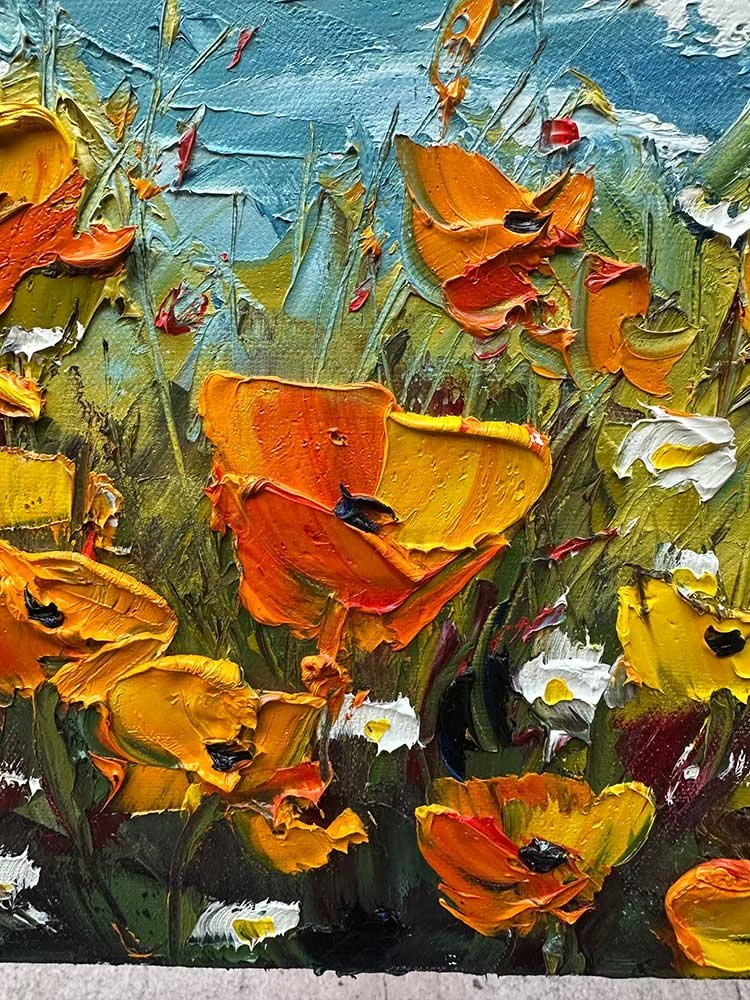
The Moment Your Life Changes Is the Moment You Stop Abandoning Your Truth
There’s a turning point in every career and every life.
Not a dramatic breakthrough or a cinematic epiphany, but a quiet, almost private moment where your body tells the truth long before your mind is willing to admit it.
It’s the moment you stop abandoning yourself.
Most people never realize this, but your clarity, your health, your resilience, and even your confidence don’t expand because you push harder, optimize your habits, or perfect your routines.
They expand at the frequency of your truth.
Because when your inner world and outer world finally match, something remarkable happens:
Your energy returns.
Your focus sharpens.
Your nervous system settles.
Your decisions simplify.
Your path becomes unmistakably yours.
And your body feels the shift instantly.
Because your body always knows.
It knows when you’re people-pleasing your way through meetings.
It knows when you’re saying “yes” while everything inside you says “no.”
It knows when you’re staying in roles, rooms, or relationships you’ve quietly outgrown.
It knows when you’re performing stability instead of living it.
And misalignment, even subtle, polite, socially acceptable misalignment, takes a toll.
Not emotionally.
Biologically.
Cortisol rises.
Breathing shallows.
Energy drains.
Heart-rate variability drops.
Your system shifts into a low-grade state of protection because some part of you recognizes,
“This isn’t honest.”
But here’s the part we’re never taught:
The moment you stop abandoning your truth, even in small, barely perceptible ways, your entire system reorganizes.
Your breath deepens.
Your shoulders drop.
Your thinking clears.
Your decision-making becomes clean and quiet.
Your body moves from defense into coherence, a measurable, biological state of alignment where your thoughts, emotions, and actions finally work in the same direction.
Authenticity isn’t a personality trait.
It’s a physiological advantage.
Coherence isn’t a spiritual concept.
It’s a state your nervous system recognizes as safety.
And truth isn’t a luxury.
It’s home.
When you stop masking…
when you stop explaining yourself into exhaustion…
when you stop shrinking to preserve the comfort of everyone around you…
You create the internal conditions for your intelligence to come back online.
Your creativity increases.
Your confidence stabilizes.
Your communication sharpens.
Your leadership becomes grounded instead of reactive.
Your life, internally and externally, recalibrates around what is real.
Not because everything suddenly becomes effortless,
but because you’re no longer leaking energy toward the performance of who you’re not.
Growth doesn’t ask you to become someone new.
It asks you to stop abandoning who you already are.
So if you’re feeling tired, unclear, disconnected, or strangely “off”…
the question might not be:
“What’s wrong with me?”
The question might be:
“Where am I still betraying my own truth?”
Because the moment you stop…
the moment your inner world and outer actions align…
Your biology shifts.
Your energy returns.
Your confidence rises.
Your path becomes obvious.
Your truth doesn’t just change your life.
It recalibrates your entire field.
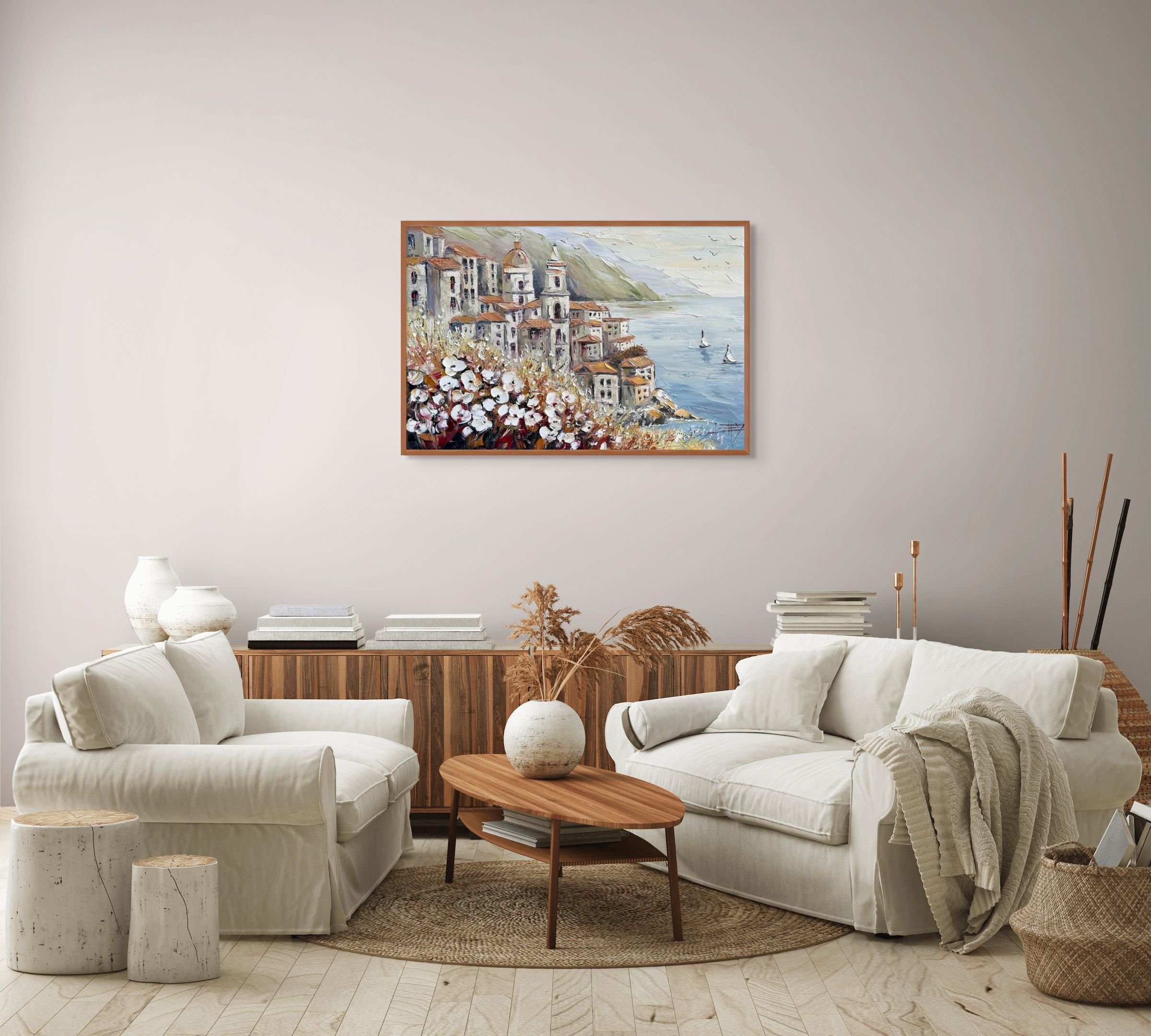
Crowned by Coastal Light 36×24”
When the Quiet Ending Finally Lands
There are endings that arrive with noise and rupture…
and then there are the quiet ones.
The endings that unfold slowly, respectfully, almost silently,
so gently that you only realize a chapter has closed
after you’ve already stepped into something new.
My twenty-four–year marriage ended this way.
There was no dramatic exit.
No explosion.
No crisis point.
Just a gradual untethering of two people who had built a life together,
still sharing the same home while navigating logistics, timing,
and the realities of starting over.
It was peaceful.
Practical.
Human.
And for a long time, I didn’t understand why I still felt subtly “held in place,”
even after the emotional and mental clarity had arrived.
It wasn’t until I moved into my new casita studio,
a small space with beautiful natural light
and a quiet outdoor area where I can paint,
that something in me finally shifted.
Not dramatically.
Not euphorically.
Just… cleanly.
A soft internal click I didn’t know I’d been waiting for.
What I’ve learned is this:
The mind can accept an ending long before
the nervous system completes it.
Long-term partnership creates an unconscious choreography,
tiny adjustments in rhythm, energy, and awareness.
Even in peaceful relationships, your nervous system tracks another person’s presence.
You don’t simply “turn that off”
because the marriage contract is ending.
But the moment I set my things down in a space that held only my energy,
no shared routines, no subtle attunements, no overlapping emotional weather,
my body exhaled in a way it hadn’t in years.
And in that stillness, I met a version of myself
I had not heard clearly in a very long time.
Calm.
Clear.
Steady.
Fully present.
What surprised me most was how immediately my creativity responded.
The casita is small, but the light is generous.
The air feels different.
The quiet is spacious.
And the work that is emerging from this studio carries a new frequency,
more refined, more elegant, more honest.
It feels like the beginning of a new era in my art.
A softening of palette.
A gentler tempo.
A sense of clarity I couldn’t access while I was still living in an in-between space.
Quiet endings do that.
They create the conditions for quiet beginnings.
Many of us move through transitions that don’t come with big declarations,
the end of a relationship,
a career pivot,
a shift in identity,
a season of life that no longer fits.
We often wait for something dramatic to “prove” the change is real.
But sometimes the most meaningful transformations arrive quietly,
without burning anything down
or tearing a chapter apart.
Sometimes the shift begins the moment you enter a space
where nothing in you has to brace or accommodate anymore.
A space where your nervous system stops tracking anyone but you.
A space where the future isn’t forced.
A space where you can finally hear yourself again.
I’m in that space now.
Painting in natural light.
Breathing my own rhythm.
Letting the work lead the way.
It feels good.
Simple.
True.
If you’re in a quiet ending of your own, I hope this reminds you:
You don’t need catastrophe to justify change.
You don’t need drama to validate what you feel.
You don’t need permission to step into a chapter that already belongs to you.
Sometimes the beginning arrives
the moment the quiet finally lands.
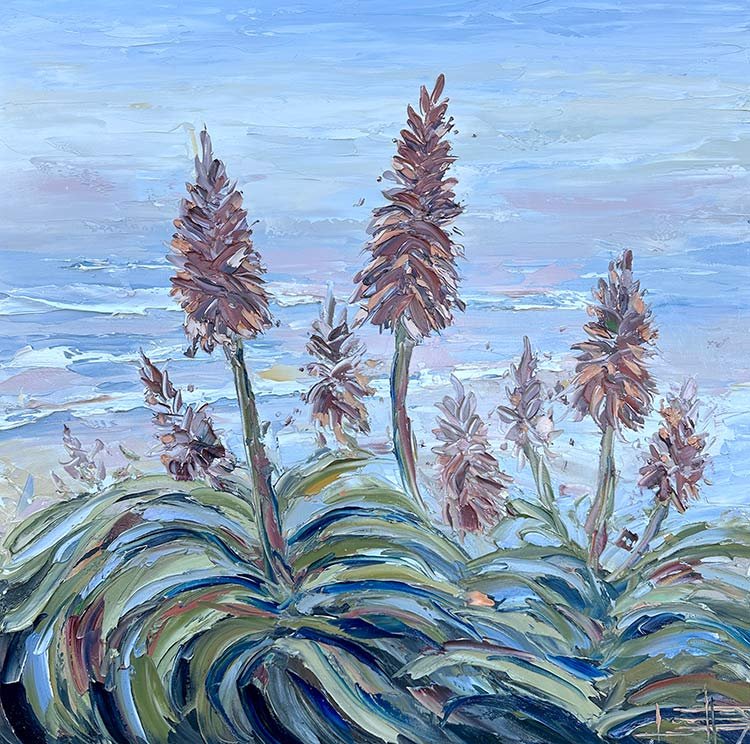
Why Environment Matters for Creative Work
I’ve been reflecting a lot on the relationship between space and creativity, not as an abstract idea, but as something I’ve lived through deeply over the past few years.
For a long time, my art was made in borrowed corners, shared rooms, temporary setups, and whatever little pockets of space were available in the moment. If you’re a creative of any kind, you probably know that dance: adapting, improvising, doing your best with what you have.
Scrappiness is a skill.
It builds resilience, discipline, and resourcefulness.
But over time, I’ve learned something important:
Your creative work can only expand as far as your environment allows it to.
Recently, I moved into a small casita studio, a quiet, bright space that is entirely my own, and almost immediately, everything shifted. Not dramatically, not loudly, but in that subtle, grounded way clarity always arrives:
My nervous system settled.
My focus sharpened.
My ideas felt roomier.
My routines felt easier.
My work felt more intentional.
It reminded me of a truth I had temporarily forgotten:
environment is part of the creative process.
It’s not just the backdrop.
It’s not just where you “happen to be” while you work.
It shapes the quality of your focus, the depth of your thinking, and the energy you bring to your craft.
A supportive environment doesn’t magically do the work for you, but it creates conditions where your best work becomes possible, sustainable, and joyful.
If you’ve been feeling stretched thin or stuck in a creative rut, it might not be your ideas or your motivation. It might simply be that you’ve outgrown the environment you’ve been working in.
Sometimes the most important upgrade isn’t a tool or a technique.
It’s the place you sit down to create.
Here’s to new chapters, new spaces, and the work that can finally breathe because of them.
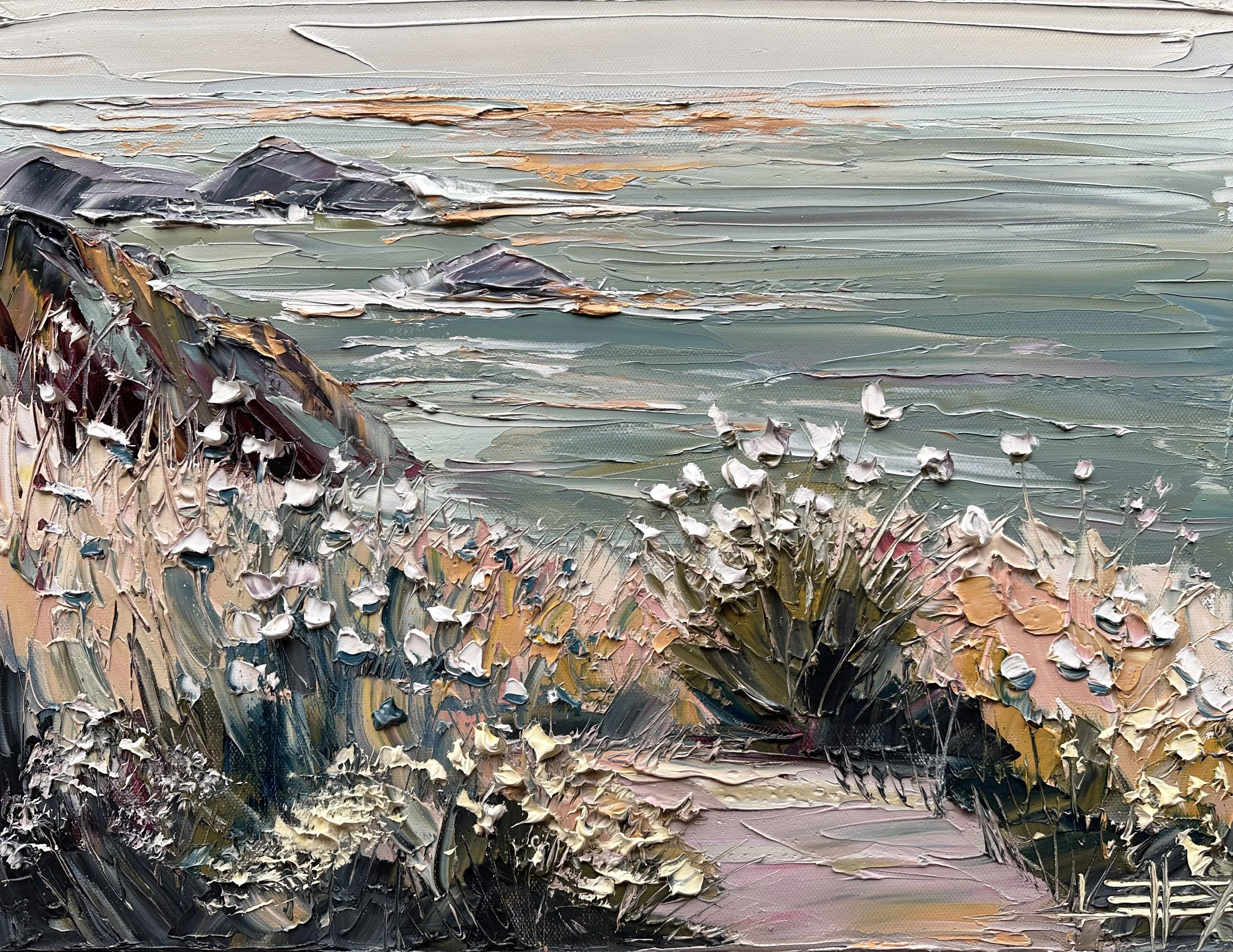
Where the Wildflowers Wait, available exclusively on Ugallery.com
Gratitude Isn’t Soft, It’s Strategy
As we head into Thanksgiving, I’ve been thinking a lot about gratitude, not the big, glowing, Instagram-worthy kind, but the quieter form that has shaped nearly every turning point in my life.
The kind that doesn’t need a spotlight.
The kind that doesn’t announce itself.
The kind that rewires your inner world long before the outer world catches up.
For years, I misunderstood gratitude as another “performance metric”, something to list in a journal, something to recite, something to use as evidence that I was being a good person, a positive thinker, a disciplined creator.
But real gratitude isn’t performative.
It’s directional.
It doesn’t ask you to paste a smile over a hard moment.
It doesn’t require you to deny your feelings.
It doesn’t demand a spiritual bypass or a fake sense of joy.
Instead, real gratitude does something much quieter, and infinitely more powerful:
It stabilizes the system.
It grounds you in what’s real, not what’s missing.
It shifts your field from frantic to coherent.
It helps you see possibility instead of threat.
And it returns you to the version of yourself that makes better decisions, builds bolder things, and trusts the long game.
Gratitude, in its purest form, is clarity.
It brings you back into your body.
It brings you back into your values.
It brings you back into the moment where your life is actually happening, not the one you’re trying to outrun or control.
And when your nervous system comes back online, when the noise settles, and when you’re able to breathe again from your actual center… everything begins to shift.
Your creativity opens.
Your resilience strengthens.
Your next steps become obvious.
And the world stops feeling like something you need to brace against.
This year, my gratitude practice has been less about lists… and more about listening.
Less about saying “thank you”… and more about noticing the moments when I feel anchored, present, and steady.
Less about chasing the peak… and more about honoring the calm.
Gratitude isn’t soft. It’s not fluffy. It’s not something you sprinkle on top of a chaotic life.
Gratitude is strategy.
Because when you stabilize the inner field, the outer world organizes itself around that stability.
When you move from coherence, the path clears faster.
And when you stay connected to what’s here instead of what’s missing, you stop performing and start living.
So as we step into Thanksgiving week, here’s the quiet truth I’m landing in:
Gratitude isn’t something you practice to feel better.
It’s something you embody to become clearer.
And clarity changes everything.
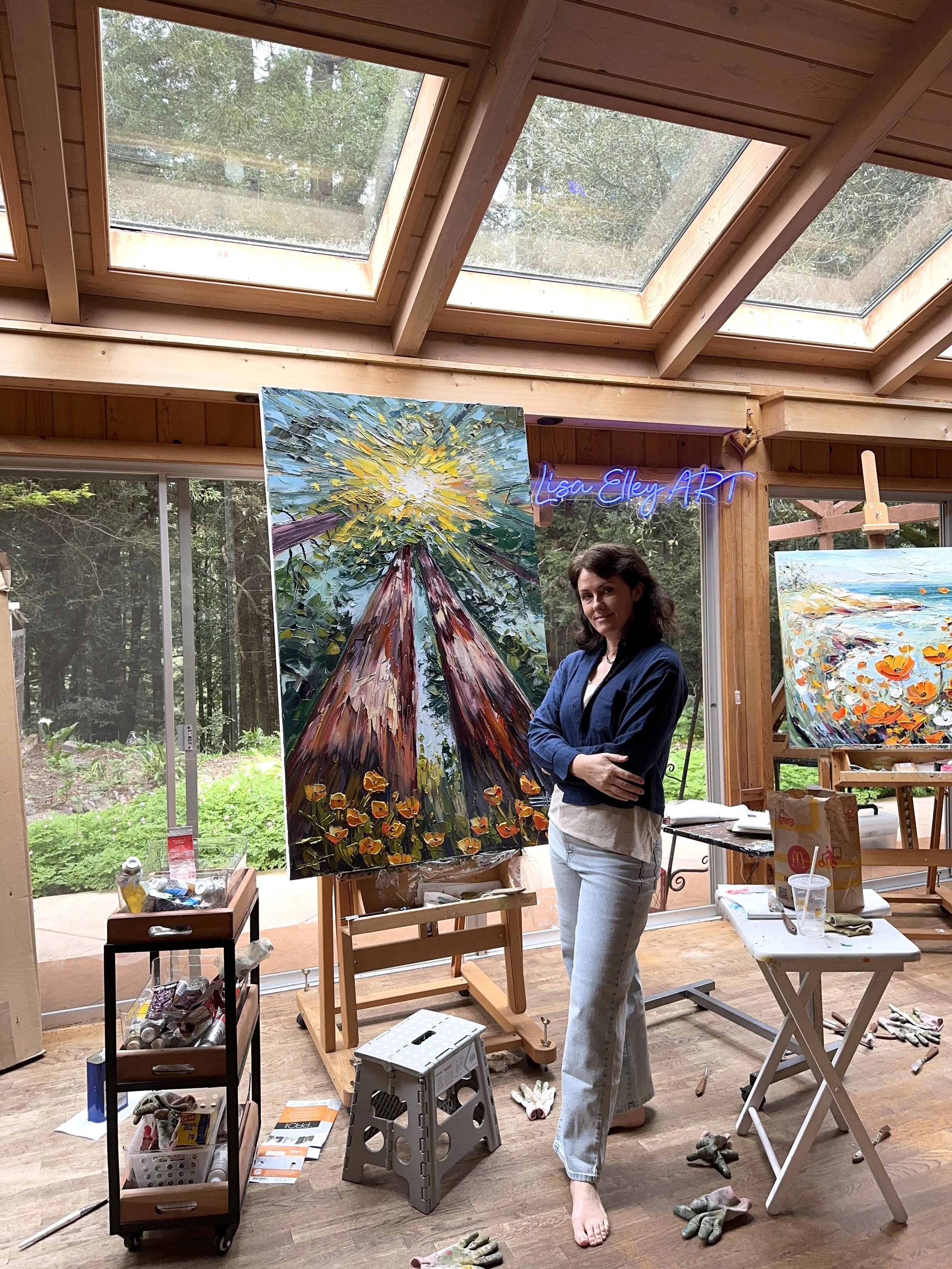
The Business of Art: Why I Only Hold One Sale a Year
A softer, behind-the-scenes look at sustainable creativity
Every year, as winter rolls in and the studio gets quieter, I take a moment to look back at the paintings that moved through my hands and into new homes. It always amazes me how much a year holds , the seasons I painted through, the places that inspired me, the collectors who supported the work, and the unexpected turns that shaped my creative rhythm.
And somewhere in that reflection, one truth always rises:
Art thrives in spaciousness, not scrambling.
That’s why I’ve made the intentional decision to hold just one sale a year.
Not because of scarcity.
Not because of urgency.
Simply because it keeps my business and my creativity aligned.
Here’s the softer story behind that choice:
Creativity Needs Integrity, Not Discounts
Every painting takes hours of layering, scraping, palette-knife carving, drying time, color-mixing, and emotional bandwidth. It’s a full-body process.
If I discounted constantly, I’d start to feel disconnected from the true value of my work.
And I’d lose the grounded pace that makes each piece feel alive.
One annual sale lets me honor the art and celebrate the people who collect it without diluting either.
Collectors Deserve Clarity
Many of my collectors come back again and again, building quiet little collections over the years.
Holding a single winter sale means:
• they always know when to expect it
• it never feels gimmicky
• there’s no pressure to “wait for the next one”
• the relationship stays elegant, not transactional
It becomes a seasonal tradition, not a marketing tactic.
A Moment of Appreciation
My winter sale is my way of saying:
Thank you.
For supporting my art.
For showing up, year after year.
For letting my paintings become part of your homes and stories.
It’s the one moment each year where I open the doors a little wider and invite people in.
No urgency.
No flashing graphics.
Just a quiet, generous gesture.
A Sustainable Business Is a Creative One
Consistent pricing the rest of the year allows me to:
• take creative risks
• explore new series
• invest in materials
• keep my studio running
• and show up fully for the work
One sale a year keeps everything steady: financially, creatively, emotionally.
It’s the structure that protects the art.
This Year’s Winter Sale Is Live
If you’ve been eyeing a painting, a Seascape, a Grande Italy, a Redwood cathedral, a coastal study, this is the moment.
The sale is already applied at checkout, quietly, without fanfare.
Exactly how I like it.
And whether you purchase something or simply enjoy the work:
thank you for being here.
It means more than you know.
My Signature Is Now a Registered Trademark® And It Feels Really, Really Good
There’s something quietly powerful about protecting your own name.
This week, I received the official notification:
My signature, the same stylized mark I’ve signed on thousands of paintings, is now a registered trademark.
It’s simple oil on canvas.
But it’s also a symbol of every palette knife stroke, every show-up day, every risk, every pivot, every whisper from the universe that said: 'keep going'.
And I did.
Now, that every angle of stroke that ends each painting has become more than just a flourish, it’s a protected identity. A legal mark. A stake in the ground that says:
“This is mine.
This is real.
This is worth protecting.”
And it feels really, really good.
Not just because of the paperwork.
But because of what it represents.
Years ago, I never imagined my art would travel this far, across the country, across oceans, across hearts. I never imagined someone would buy a painting just because it had my signature on it. And I certainly never imagined I’d be taking business calls about packaging design, IP protection, and international shipping labels.
But here we are.
And it’s not about arriving at some perfect “end.”
It’s about anchoring into the truth of what’s already been built.
This signature is a symbol.
Of commitment.
Of devotion.
Of value.
It means I’ve built something worth recognizing, and worth guarding.
It means my work matters, not just to me… but to a growing, beautiful community of collectors, partners, and fellow creatives who see the value in original, embodied, hand-made work.
And it means: I’m not going anywhere.
This isn’t a phase.
This is my life’s work.
And now, it’s legally protected too.
So here’s to whatever name you’re building for yourself.
Here’s to honoring it.
To protecting it.
To believing in it, even on the days when it’s hard to.
Because when you do…
it grows into something you can truly sign your name to.
With gratitude always,
Lisa
What We Don’t Talk About In Long Term Co Dependent Relationships
And what co-dependency really feels like
There are things you don’t see until you step out of them.
I was married for 24 years.
A solid marriage, stable, functional, loving in many ways. We raised children. Built a life. Shared holidays and inside jokes and morning routines. There was no villain. No dramatic blow-up. No story that fits neatly into blame.
And yet, when the marriage ended, I started seeing things I never saw from within it.
"You can't see the label from inside the jar", and all that.
Patterns.
Micro-adjustments.
Invisible emotional labor.
And most of all, a nervous system that had spent years attuning to someone else’s weather.
Not because I was weak.
Not because I was controlled.
But because I cared.
And because somewhere along the way, I learned that my peace depended on how “okay” someone else was.
That’s codependency.
Not in the dramatic, clinical sense,
but in the quiet, functional, high-capacity woman sense.
And I want to talk about it.
Not as a psychologist, because I’m not one,
but as a woman who lived it, unwound it, and now recognizes it everywhere.
Codependency Isn’t Weakness. It’s Over-Responsibility.
Many of us grew up learning how to regulate a room:
• We read the energy before we spoke.
• We softened our tone to avoid conflict.
• We became emotionally “fluent” in the moods of others.
Women, especially, are conditioned into this.
We’re taught to:
• Keep the peace
• Smooth the edges
• Anticipate needs
That’s not love.
That’s emotional labor.
And here’s where codependency hides:
When you regulate yourself by regulating someone else.
Not consciously.
Not maliciously.
Just… automatically.
Your nervous system learns to scan for safety by reading another person’s emotional cues.
So when they’re stressed, you feel responsible.
When they’re disappointed, you feel like you failed.
When they’re upset, you rush to fix it, not to control them, but to calm your own body.
That’s the hook.
The Physiology Behind It (A 30-Second Nervous System Lesson)
When we spend years emotionally attuning to a partner, our nervous system forms a pattern called:
➡ Insecure co-regulation
Your body outsources safety to the other person’s emotional state.
• If they’re calm, you’re calm.
• If they’re upset, your heart rate spikes.
• If they’re angry or withdrawn, you immediately scan: What did I do wrong?
This isn’t psychological weakness,
it’s physiology.
Your brain wires connection through the vagus nerve, the system responsible for safety and belonging.
When belonging feels conditional (spoken or unspoken), the body starts performing to secure it.
That’s where codependency begins:
“If you’re okay, then I’m okay.”
Why It’s Hard to See Until You’re Out
In long-term relationships, especially marriages, the fusion happens slowly.
You don’t wake up codependent.
You wake up one day and realize:
• You can predict their mood in 3 seconds.
• You’ve abandoned your truth to avoid conflict.
• You feel relief when the house is empty.
You didn’t lose yourself.
You gradually handed pieces away in exchange for harmony.
And you don’t usually see it until there’s space.
Physical space.
Emotional space.
Nervous system space.
For me, that clarity didn’t come the day the marriage ended.
It came later, in the tiny moments of neutrality,
when I stopped reacting to his emotions.
That’s when I finally heard my own.
The Unraveling (and Why It Takes Time)
We expect healing to be:
• dramatic
• immediate
• obvious
But in reality, the unwinding of codependency is… quiet.
You don’t suddenly become independent.
You gradually become sovereign.
It looks like:
• Not jumping in to fix their frustration
• Not softening your opinions to avoid tension
• Not bending your boundaries to keep the peace
• Feeling the discomfort of someone else’s mood… and not absorbing it
The first time you don’t flinch?
You’ll feel it.
You’ll feel it in your body before you see it in your mind.
It’s the moment your nervous system whispers:
“I don’t need to earn peace anymore.”
That is sovereignty.
The Steps of Unraveling (in real life, not theory)
Here’s what the process looks like, in order:
1. Awareness
You notice you’re abandoning yourself.
2. Boundary
You say no to something you’ve historically said yes to.
3. Neutrality
Their mood no longer dictates yours.
4. Self-Regulation
You stop regulating through them and start regulating through you.
5. Repatterning
Your body builds a new template for safety.
6. Freedom
You don’t perform anymore, you inhabit yourself.
That’s the timeline.
Not overnight.
Not in a breakthrough moment.
It’s gradual, cellular liberation.
Here’s the Truth Most People Don’t Say
Leaving the relationship doesn’t end codependency.
Disentangling does.
Learning to sit in your own body while someone else feels their feelings…
That’s where the real freedom lives.
So if you’re in this right now…
If you’re unraveling a marriage, a partnership, or a long-term attachment;
You’re not behind.
You’re not broken.
You’re not too late.
You are reentering your own life.
One regulated breath at a time.
P.S. If you’re learning how to regulate yourself instead of regulating the room… Lumera was born from that exact shift.
Lumera is a 15-20-minute nervous-system practice that helps you return to your own center, without sitting still in silence or forcing calm.
No performance.
No perfection.
Just coherence.
🔗 Learn more: https://windsweptstudio.com/lumera-meditation
This Is Not a Hologram, A Grounded Take on Reality, the Field, and Human Consciousness
Every few months, I see another wave of people talking about how our human life is just a hologram. A simulation. A matrix.
And while the metaphor is interesting, I’ve never fully resonated with it.
Because the more I’ve lived inside my own body, not my mind, the more clear it becomes:
This is not a hologram.
Not in the way people mean it.
What we’re experiencing isn’t an illusion we need to wake up from.
It’s a participatory field we’re learning how to collaborate with.
And the difference between those two ideas changes everything about how we create, how we lead, and how we move through our lives.
Why the Hologram Metaphor Is So Alluring
A hologram suggests that everything is just light and information.
Each part contains the whole.
Change one pixel, and the entire projection reorganizes.
It’s a poetic metaphor, especially for those of us who believe in the interconnectedness of all things.
And on some level, it’s true: consciousness and quantum information do underpin the physical world.
But the literal interpretation, that life is a fake projection or a cosmic video game,
misses the entire point of being human.
Because when you’re in a body, when you’re breathing, feeling, sensing, touching the world through fascia and heartbeat and gravity…
it stops feeling like a trick of the light.
It starts feeling like something far more intimate:
The universe is not a simulation, it’s a conversation.
A living, breathing dialogue between the field and your nervous system.
The Participatory Field: A More Accurate Model of Reality
Physicist John Wheeler proposed that we live in a “participatory universe,”
where observers aren’t separate from reality,
they’re co-authors of it.
Not programmers.
Not puppets.
Partners.
Your consciousness offers potential.
Your body translates that potential into electrical signals.
Your emotional coherence stabilizes it.
And matter responds.
Not instantly, not magically, but predictably, the way water forms patterns around steady vibrations.
This is not illusion.
This is physics meeting presence.
Density Is Not the Problem. It’s the Privilege.
People often talk about wanting to transcend density,
to rise above the body, the emotions, the delays, the friction.
But density is what makes meaning possible.
You can’t see sunlight without atmosphere.
You can’t feel love without form.
You can’t create art without resistance.
Matter isn’t something to escape.
It’s what allows consciousness to show itself.
Being human is how the quantum field becomes touchable.
Your Body Is the Translation Device
If you’ve ever felt a “download” as a tingle, a hum, a jaw buzz, a swelling in your chest,
that’s your nervous system receiving coherence information from the field.
Not a glitch in the matrix.
Not evidence of unreality.
Evidence of partnership.
Your body is the instrument.
The field is the music.
Coherence is the tuning.
When you regulate your breath,
when you drop into neutrality,
when you stop performing for reality and simply inhabit yourself,
the field stops broadcasting noise and starts sending clarity.
This is why embodiment matters more than visualization.
Why presence matters more than belief.
Why safety matters more than striving.
The Feedback Loop: How Creation Actually Works
Here’s the part most people skip:
Reality doesn’t respond to what you want.
It responds to who you are while you’re wanting it.
Coherence creates a feedback loop.
Agitation scrambles it.
Neutrality stabilizes it.
Gratitude amplifies it.
Stillness clarifies it.
When you’re calm, the field can reorganize.
When you’re dysregulated, the signal is fuzzy.
It’s not personal.
It’s physics.
You’re Not Here to Hack a Simulation
The problem with the “matrix” metaphor is that it tempts the mind into control:
If this is a simulation, I should be able to hack it.
Code it.
Manipulate it.
But real manifestation, the kind that sticks, doesn’t come from control.
It comes from resonance.
You don’t bend reality through force.
You invite it through coherence.
Because at the end of the day:
You’re not escaping reality. You’re collaborating with it.
That’s where the magic is.
That’s where the clarity is.
That’s where everything begins to shift without the adrenaline, without the chase.
A New Paradigm of Creation
So maybe it’s time to let the hologram metaphor go.
Not because it’s wrong, but because it’s incomplete.
We’re not avatars waking up from a dream.
We’re participants learning how to feel the field through the body.
Breath by breath.
Word by word.
Choice by choice.
A leader isn’t someone who hacks the system.
A leader is someone who becomes so internally coherent
that reality can’t help but rearrange around their steadiness.
This is where I see so many of us heading,
into a more grounded, embodied, elegant era of creation.
One where nervous-system intelligence becomes the new literacy.
Where coherence becomes the new confidence.
Where collaboration with the field becomes the new creativity.
Closing Thought
As you move through your day, try this:
Look at your life not as a hologram to escape,
but as a living conversation that’s happening through your breath, your presence, and your choices.
Let the ordinary moments,
your coffee, your emails, your walk to the mailbox
be the field speaking back to you.
Not a trick.
Not a test.
Just intimacy.
This is not a hologram.
This is home.
If this landed for you, here’s the part most people miss:
You don’t need to “wake up from the matrix.”
You just need to wake up inside your own body.
Because once you do that?
Reality stops feeling like something you have to outsmart…
and starts feeling like something you can collaborate with.
And if you’re exploring this shift:
from performing → to presence,
from hacking → to coherence,
from control → to actual partnership with your life
I talk about this a lot on my podcast.
Not as doctrine.
As lived experience.
You can listen to my podcast here
And if you want a simple, grounded way to practice it in real time, the Lumera Method™ is the one I created for myself.
It’s not meditation.
It’s nervous-system literacy.
A way to return to yourself without needing to escape anything.
No pressure.
No performance.
Just truth.
Because here’s the thing:
Your life isn’t a hologram.
It isn’t a test.
It isn’t a trick.
It’s a conversation
and the moment you start responding from your body instead of your fear,
everything changes.
Not magically.
Not instantly.
But unmistakably.
So today, try this:
Let the ordinary moments answer you back.
Your coffee.
Your inbox.
Your drive.
Your breath.
If you listen closely, you’ll hear it:
Not a projection.
Not a simulation.
Home.

🎨 The Cost of Exposure: When Sharing Isn’t Support
A few days ago, an aggregate art account on Instagram reposted one of my reels without asking. It was a personal, voice-led video, just me in my studio, talking about the San Francisco Bay and the painting I’d made in response to it.
They didn’t tag me.
They didn't invite me as a collaborator (amongst a host of other 'art accounts' they did invite)
They didn’t ask.
They didn’t even change the caption.
They just took the whole thing, my words, my art, my face, my voice, and reposted it as “content” for their page.
And unfortunately, this happens all the time.
What’s really going on here?
On the surface, these accounts look harmless. They post daily art “for inspiration.” They feature a rotating collection of work, often accompanied by a short quote or generic caption. At first glance, it looks like they’re celebrating artists.
But a closer look tells a different story.
Most of these pages are monetized. They’re collecting art from working, living artists and using it to drive traffic, engagement, and affiliate income, without permission, without pay, and without any meaningful credit. It’s not a collaboration. It’s a siphon.
And every time these accounts get liked or shared, it reinforces a model that undermines the very artists they claim to promote.
It’s not just frustrating, it’s extractive.
When a reel is reposted without consent, it removes the artist from their own work. It severs the relationship between viewer and creator. It strips away context, nuance, and connection, and instead turns original creative labor into generic content meant to boost someone else’s page.
Art doesn’t exist in a vacuum. It’s made in real time, by real people, under real conditions, and that effort is worth respecting.
What I did about it, and why I didn’t shrink
This time, I didn’t ignore it.
I commented directly and asked them to take it down. Kindly. Clearly. No drama. Just a boundary.
Because I no longer believe that silence is graceful.
Or that artists should be grateful just to be seen.
Or that the only way to grow is to play nice while others profit from your work.
This isn’t about calling anyone out, it’s about calling the industry up.
If you’re someone who follows art accounts like these:
• Take a moment to look for the original artist.
• If there’s no clear credit or tag, ask why.
• Better yet, follow and support the artist directly.
Even just liking, saving, or sharing the work from its original source makes a difference.
And if you’re a fellow artist:
You don’t have to justify why this feels bad.
You’re not too sensitive for caring.
You’re not “ungrateful” for expecting basic respect.
You are allowed to protect your signal.
Because your work is not just beautiful, it’s valuable.
And when someone tries to use it without permission, it’s okay to say:
No. Not like that. Not anymore.
🌀 I’d love to hear your thoughts:
Have you experienced this kind of IP or content extraction?
How do you respond when your work is used without credit?
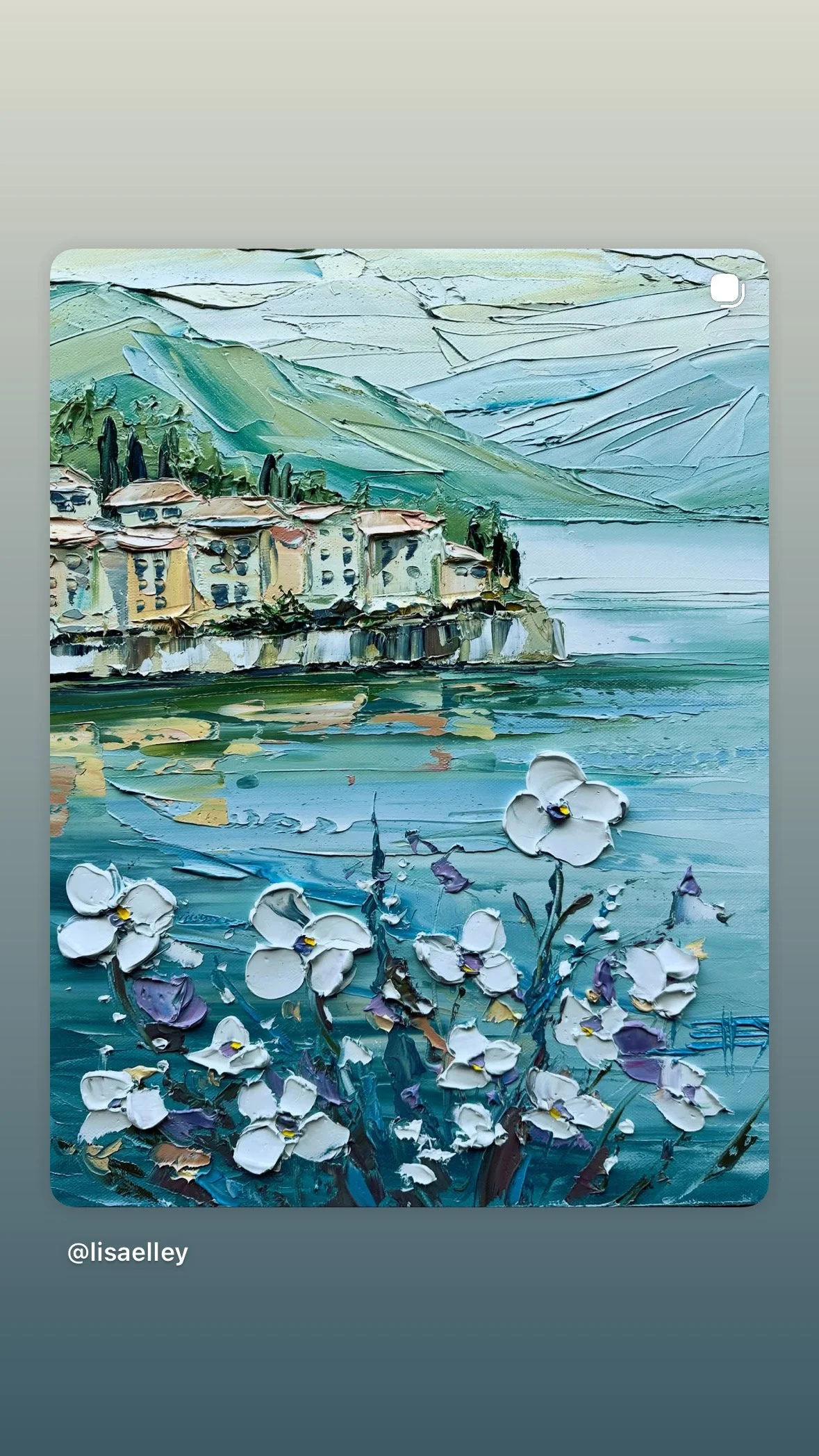
🖼️ And if you’re looking to support artists more directly, come follow along at @lisaelley or explore my latest collection here.
The Grande Italies: Art You Can Step Into
There are places you visit…
and then there are places that imprint on you.
Italy imprinted on me.
Not just because it’s beautiful,
but because it invites you to slow down and actually see.
See the way morning light softens stone.
See the way color lives in shadow.
See the way a place can hold you without saying a word.
Every time I walk through Venice, Florence, or along the coast, I feel the same shift inside me:
My nervous system drops into presence.
My breath gets deeper.
My shoulders let go.
And with that comes clarity.
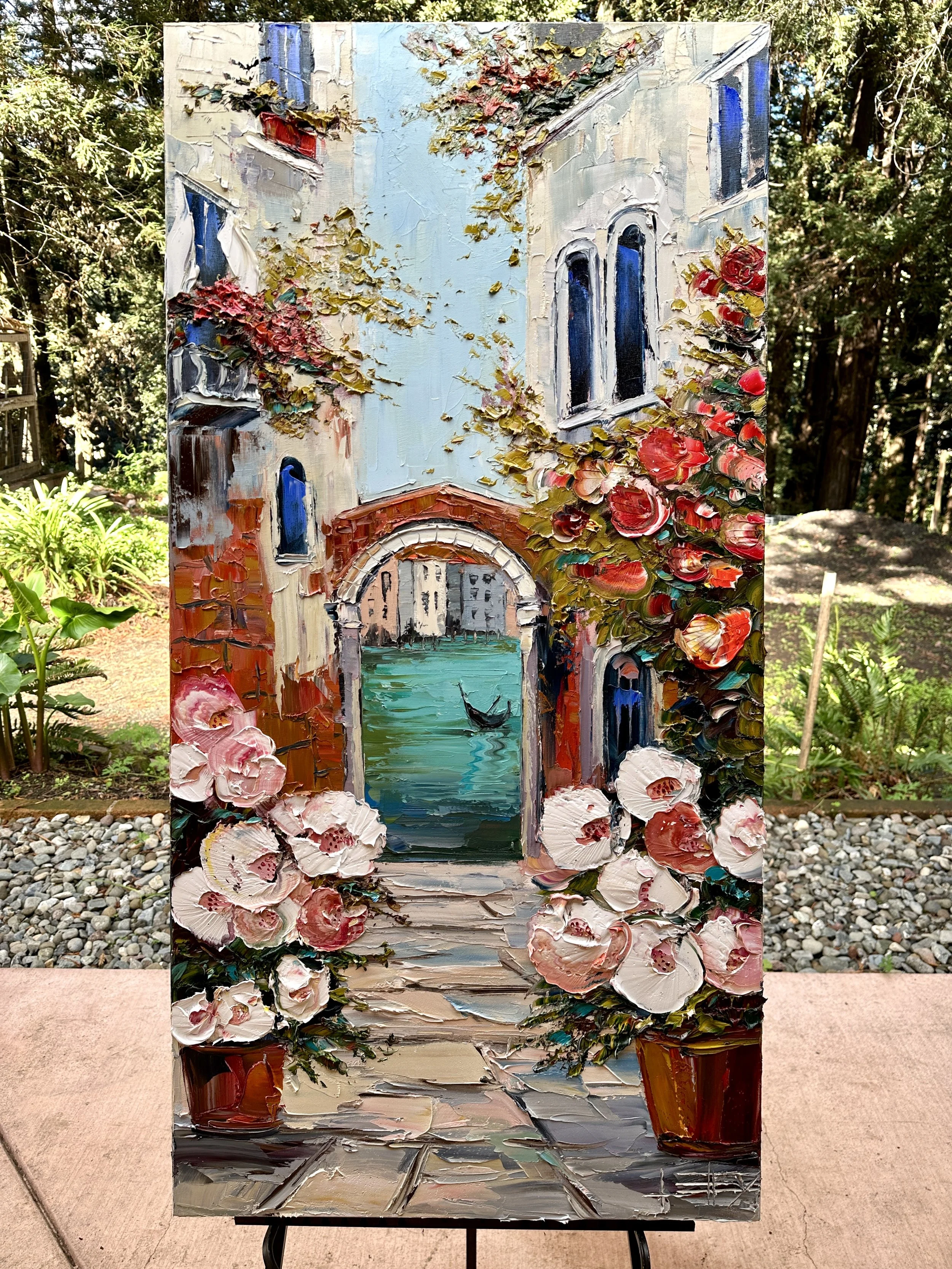
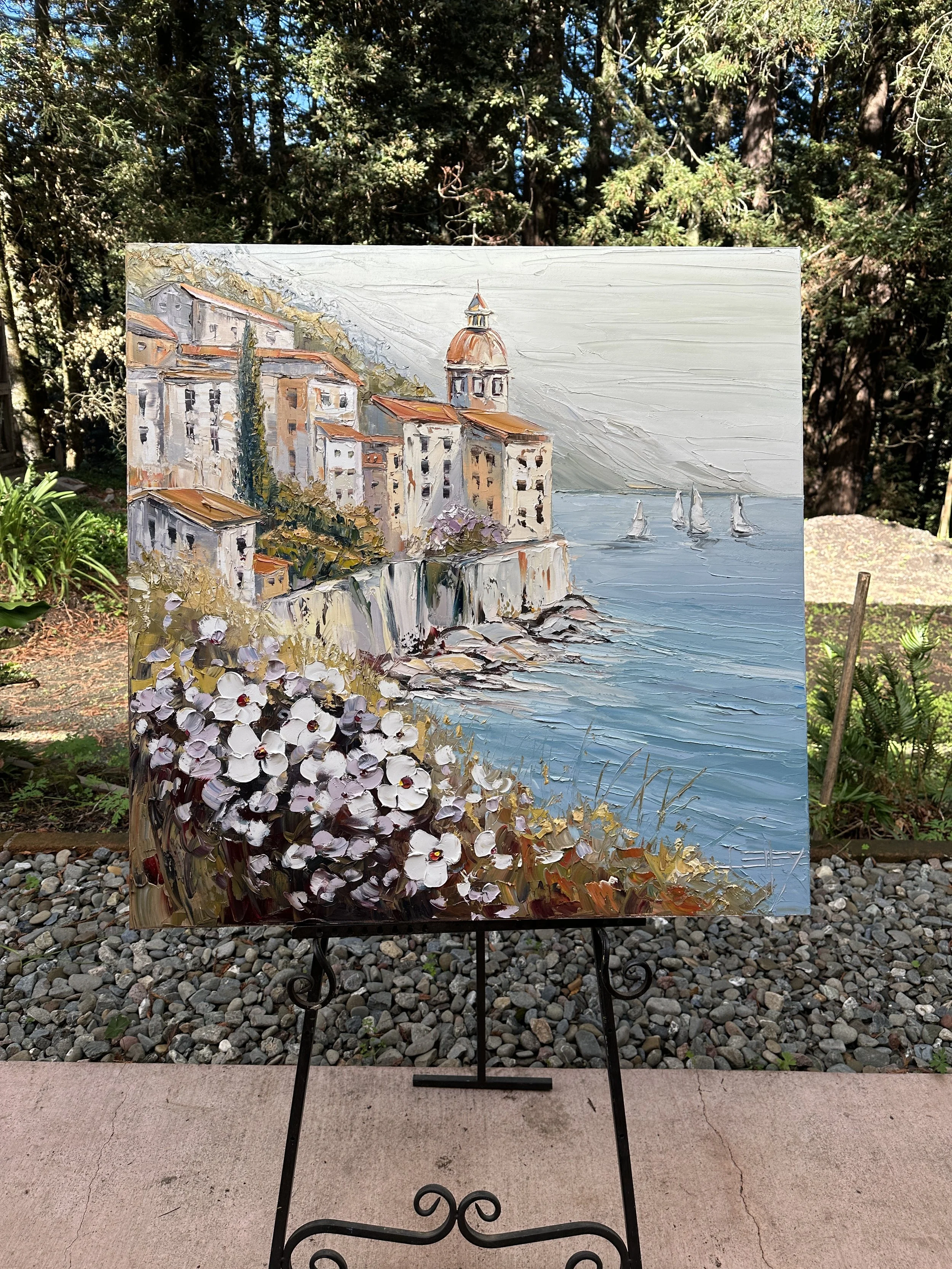
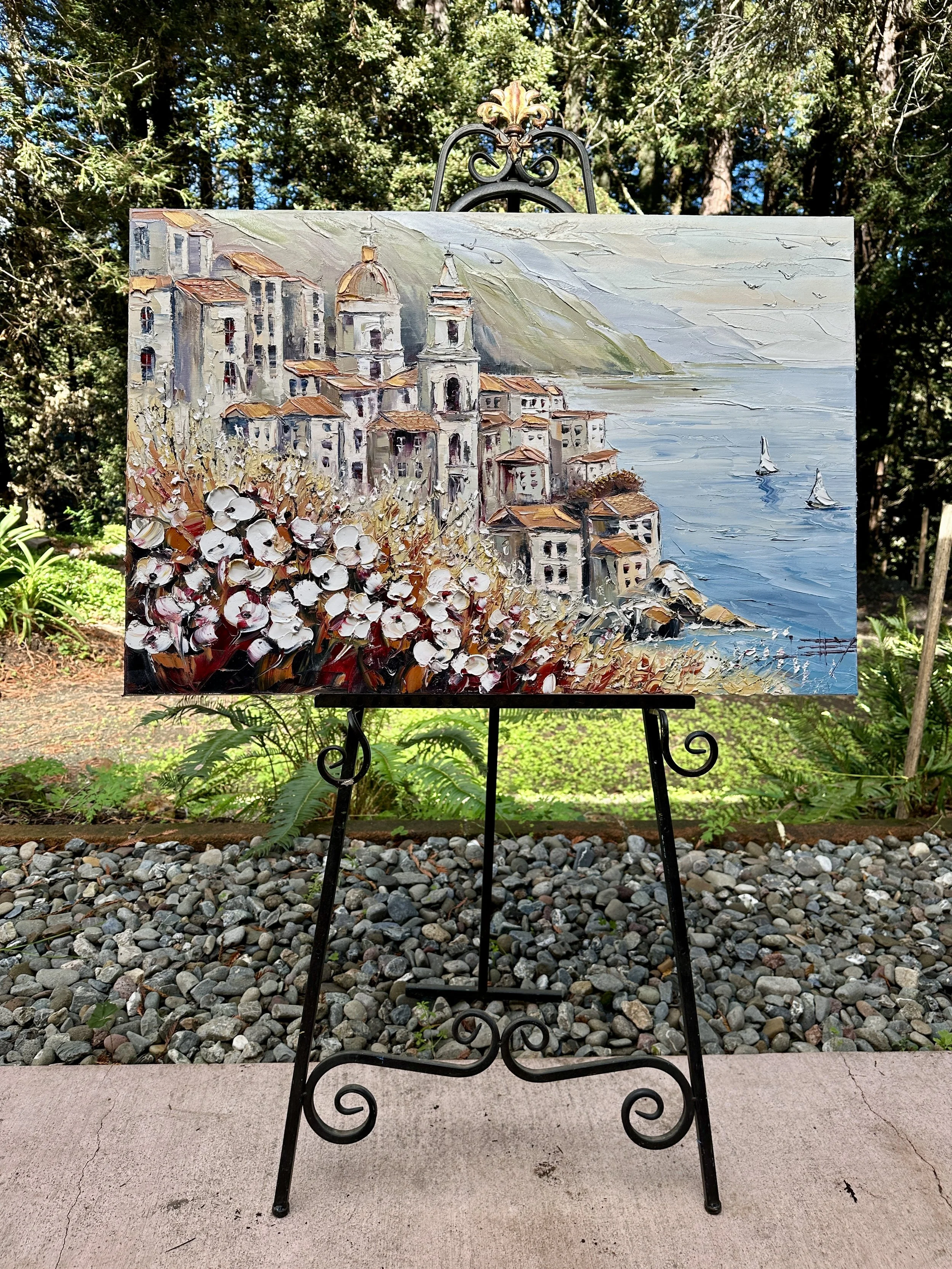
That clarity is what inspired The Grande Italies, my large-scale, palette knife oil series that captures the emotional architecture of Italy through texture, color, and scale.
Not a postcard version of Italy.
A felt version.
Why Grande? Why Large Scale?
Some emotions don’t belong on small canvases.
Italy isn’t subtle.
It isn’t quiet.
It isn’t meant to be contained.
Large canvases 24x48, 36x36 force honesty.
There’s no overthinking when your knife meets a canvas that size.
There’s only movement. Decision. Presence.
On a grande scale:
Texture becomes sculptural
Color becomes immersive
The painting becomes a place, not an object
The canvas stops being decoration
and starts being experience.
Texture as Architecture
In Italy, even the walls have stories.
Layers of plaster.
Edges softened by time.
Patches where history shows through.
I don’t use brushes for that reason.
I use palette knives
steel against paint
because knives allow the paint to build, layer, and catch light the same way old plaster walls do.
With every swipe, there’s commitment.
With every ridge, there’s history.
These pieces aren’t smooth.
They’re alive.
The Palette: Soft Light, Warm Stone, Quiet Water
Every color in the Grande Italies series is chosen intentionally.
Blush tones of early evening on Venetian canals
Sandstone, ivory, and warm whites of sun-aged architecture
Sage and slate from the reflection of water on old stone
The colors are muted but radiant.
Elegant.
Understated.
Timeless.
They bring calm, not chaos.
Presence, not noise.
For the Collector Who Wants a Feeling, Not a Souvenir
Art doesn’t have to shout to be powerful.
The most striking rooms often have one focal point, not many.
A single large painting that anchors the space.
The Grande Italies are for collectors who value:
Quiet luxury
Texture you can see and feel
Depth without heaviness
Art that evokes a place and a memory
I’ve had collectors tell me:
“Your Italy pieces feel like breathing.”
“This one painting changed the energy of the whole room.”
That’s exactly what I want them to do.
Featured Release: Venetian Bloom (24x48)
The newest piece in the series just went live:
Venetian Bloom 24x48 palette knife oil on canvas.
It’s romance in soft ochre and blush tones.
Bold texture.
Delicate palette.
A statement without shouting.
Available now, first come, first collected.
👉 View Venetian Bloom and the full Grande Italies collection here:
https://windsweptstudio.com/shop-f8A7B/grande-italies
A Final Thought
Italy taught me something simple and profound:
Beauty doesn’t need permission to exist.
It just does.
These paintings are a reminder of that.
A reminder to slow down.
To notice more.
To let presence be the luxury.
Thank you for being here.
Lisa
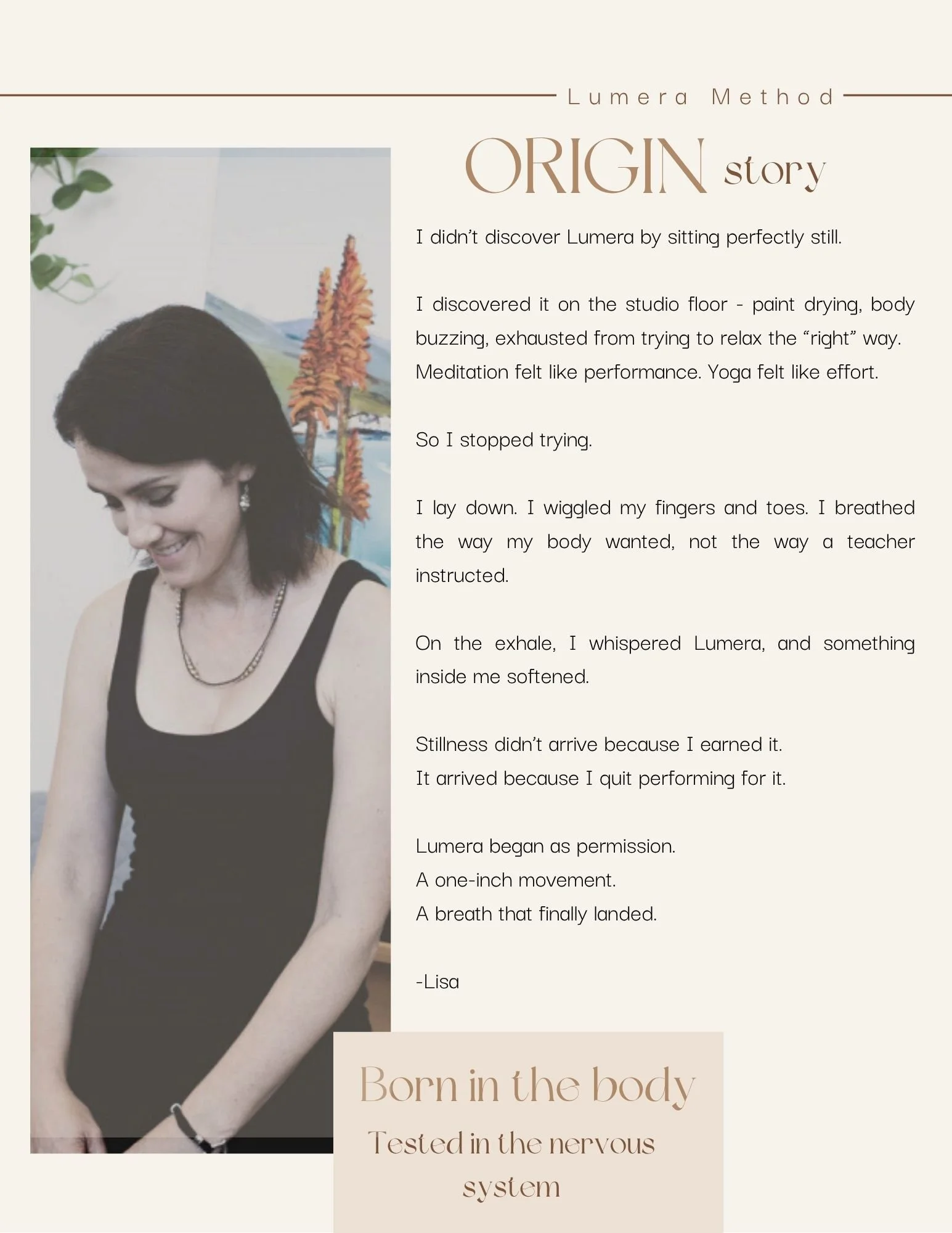
Lumera™ is here
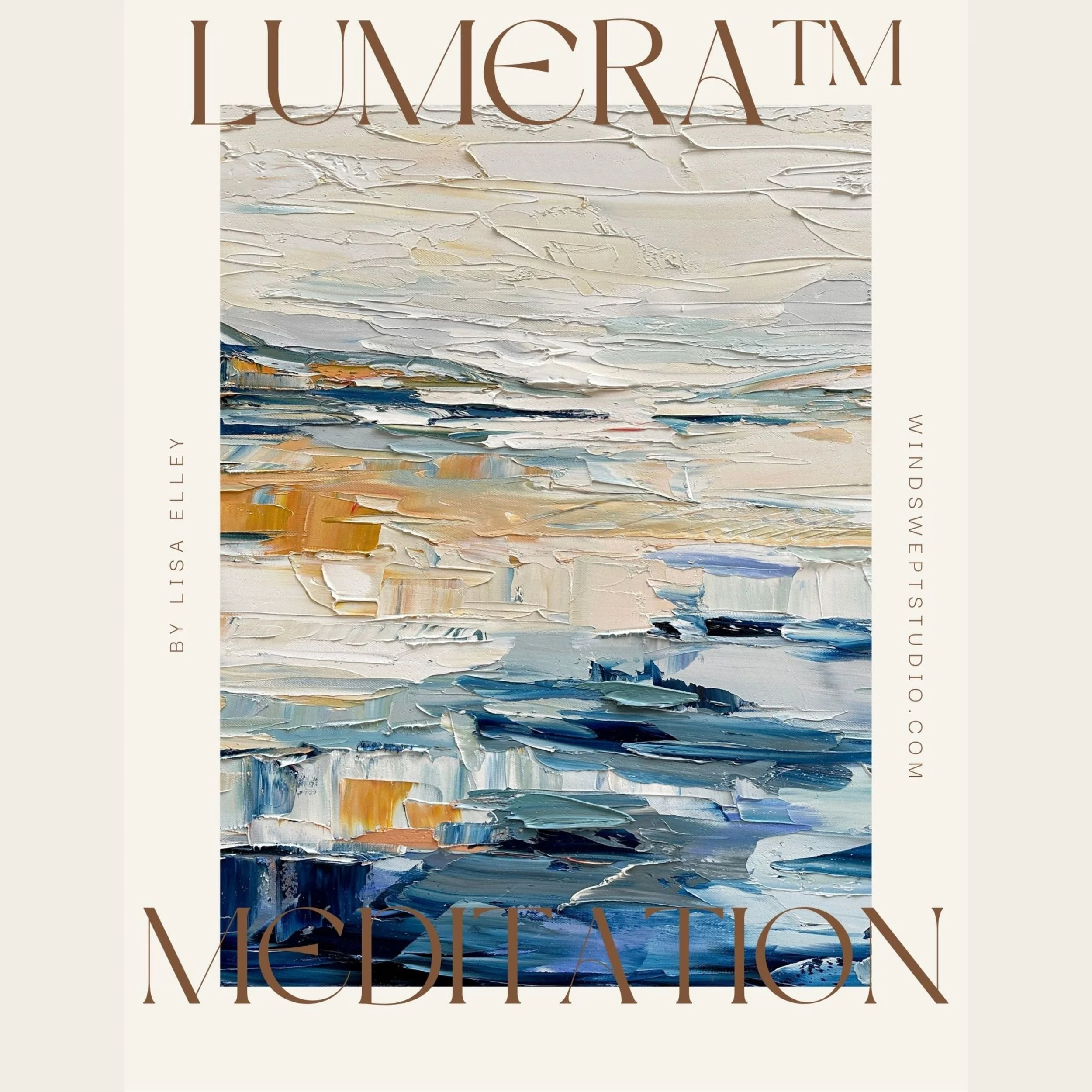
A new kind of meditation, for the ones who could never sit still.
There’s a reason I never really connected with traditional meditation.
The part where you’re supposed to transcend your thoughts.
Clear your mind.
Sit perfectly still.
My nervous system didn’t calm, it tightened.
Stillness felt like something to perform.
Like something to do right.
So I kept trying.
Until I stopped.
And I started listening to what my body actually needed.
That’s when Lumera arrived.
Lumera isn’t a technique.
It’s not visualization, hypnosis, or spiritual homework.
It doesn’t ask you to “clear your mind” or disappear from your body.
It asks you to stay.
To stay with yourself in the simplest, most human way:
A whispered phrase.
A gentle rhythm.
A soft physical cue to bring you back home.
Just enough engagement that your mind no longer has to “try.”
Just enough movement that your body feels safe to relax.
This practice was born out of lived experience.
It’s for people like me, and maybe like you
who are deeply intuitive, sensitive, intelligent…
but who carry a nervous system that’s been through too much to fake stillness.
If you’ve ever felt like meditation wasn’t for you
because you couldn’t quiet your mind the “right” way…
This is my invitation to try something different.
Lumera is now available as a 15-20 minute audio practice.
It’s not a product I’m trying to sell.
It’s a moment you get to have.
On your terms.
In your rhythm.
If it’s for you, you’ll feel it.
👉 https://windsweptstudio.com/lumera-meditation
No pressure. No performance.
Just breath.
Just return.
Just you.
Lisa
When the Yes Disappears
How to stay steady when the thing you hoped for… doesn’t happen.
There’s a moment every builder, artist, founder, or dreamer knows:
You’ve put your energy out there.
You’ve taken the risk.
You’ve followed the signs.
You’ve had the call, the meeting, the green light.
And then…
Nothing.
No follow-up.
No explanation.
Just silence.
It can feel like rejection.
Or like failure.
Or worse, like a cosmic joke.
“Why would it come into my world at all,” you wonder,
“if it wasn’t going to land?”
The part no one talks about
is how confusing it feels to hold yourself steady in that middle space.
When you’re not in defeat, but you’re not in triumph either.
You’re just… waiting. Recalibrating. Wondering what it meant.
In my own creative work, from painting to pitching, licensing to podcasting, I’ve learned to meet this moment with something softer than urgency.
Because what looks like a stalled opportunity
is sometimes just a message:
This wasn’t the destination.
It was the rehearsal.
The mirror.
The refinement.
Sometimes, the offer comes to help you practice saying yes.
Sometimes, it comes to help you practice saying no.
And sometimes, it comes to remind you that your value is real,
even if the world hasn’t fully caught up yet.
I call this the ‘coherence gap.’
It’s that space between the output and the outcome.
Where your energy was clean.
Your effort was real.
But the result doesn’t show up… yet.
Not because you did something wrong.
But because the alignment wasn’t full.
And instead of spiraling into doubt,
this is where I’ve learned to pause and ask:
What if this wasn’t about them at all?
What if it was a checkpoint for me?
A test of whether I’ll shrink or stay sovereign,
even when it gets quiet.
Here’s the truth:
Not every yes is meant to become a contract.
Not every green light is meant to be final.
But every one of them teaches you something
about who you are in the waiting.
So if something felt right and didn’t land,
you’re not crazy.
You’re not failing.
You’re not being punished.
You’re refining.
You’re becoming.
You’re building the capacity to hold what’s actually yours.
Let the beauty do the work.
Hold your posture.
Keep creating.
Stay available, not desperate.
And know this:
Sometimes what doesn’t land
is clearing space for what will.
🎧 Want more?
This week’s short podcast voice note expands on this idea:
When It Doesn’t Land, now live on Spotify + Apple.
👉 Listen on Spotify
The Quiet Stretch: My Sacred Beach Walks at Sunset State
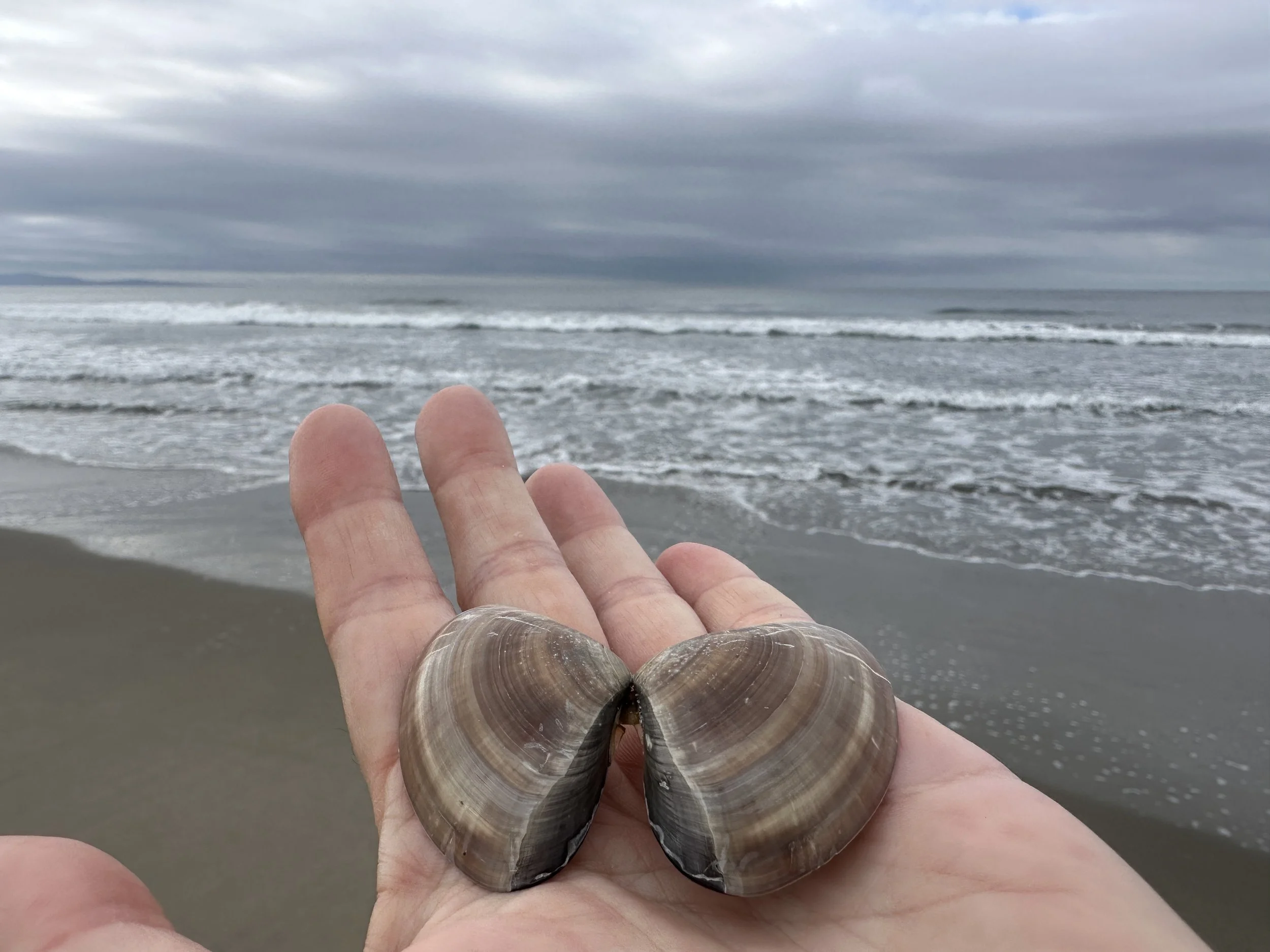
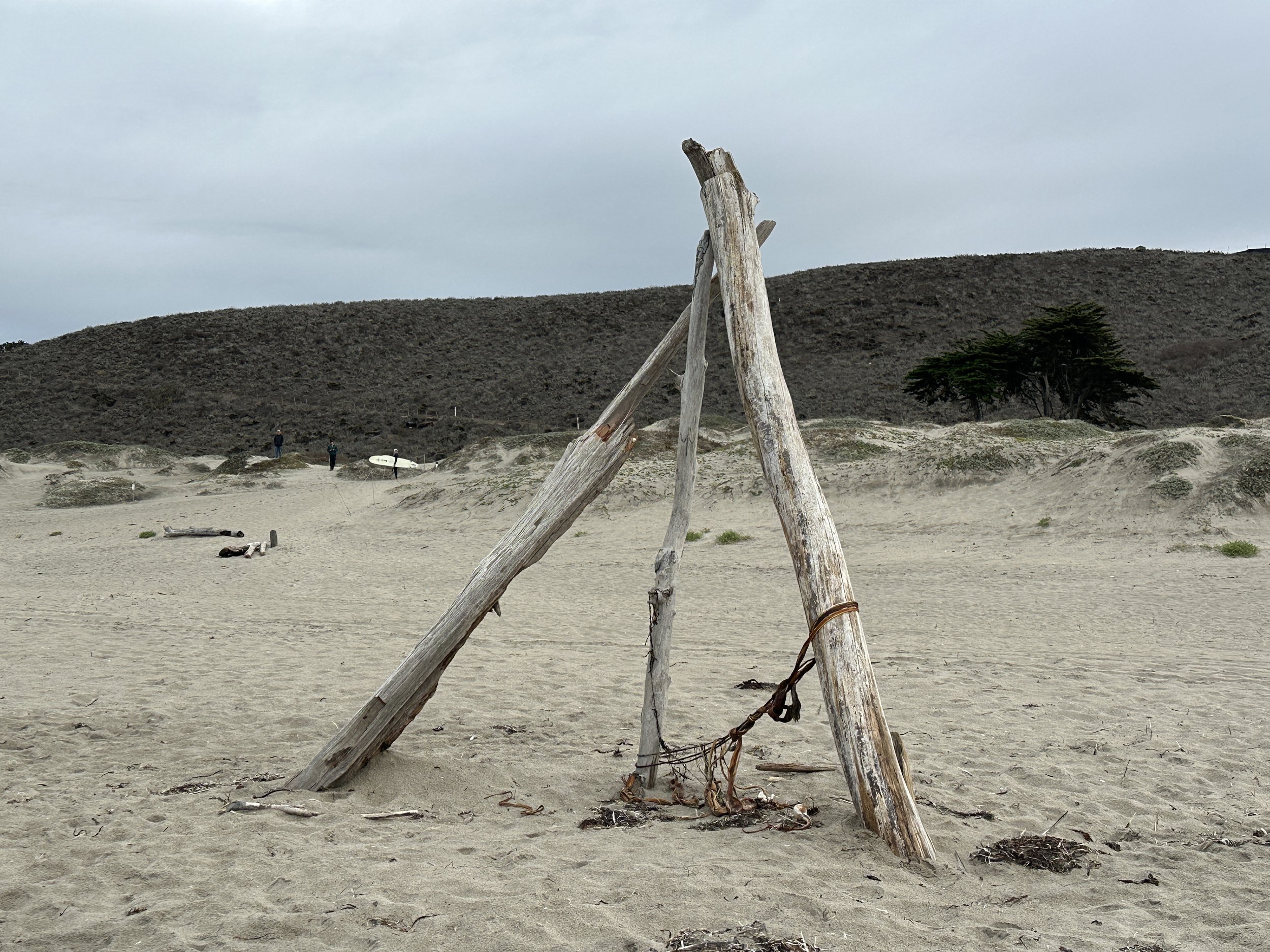
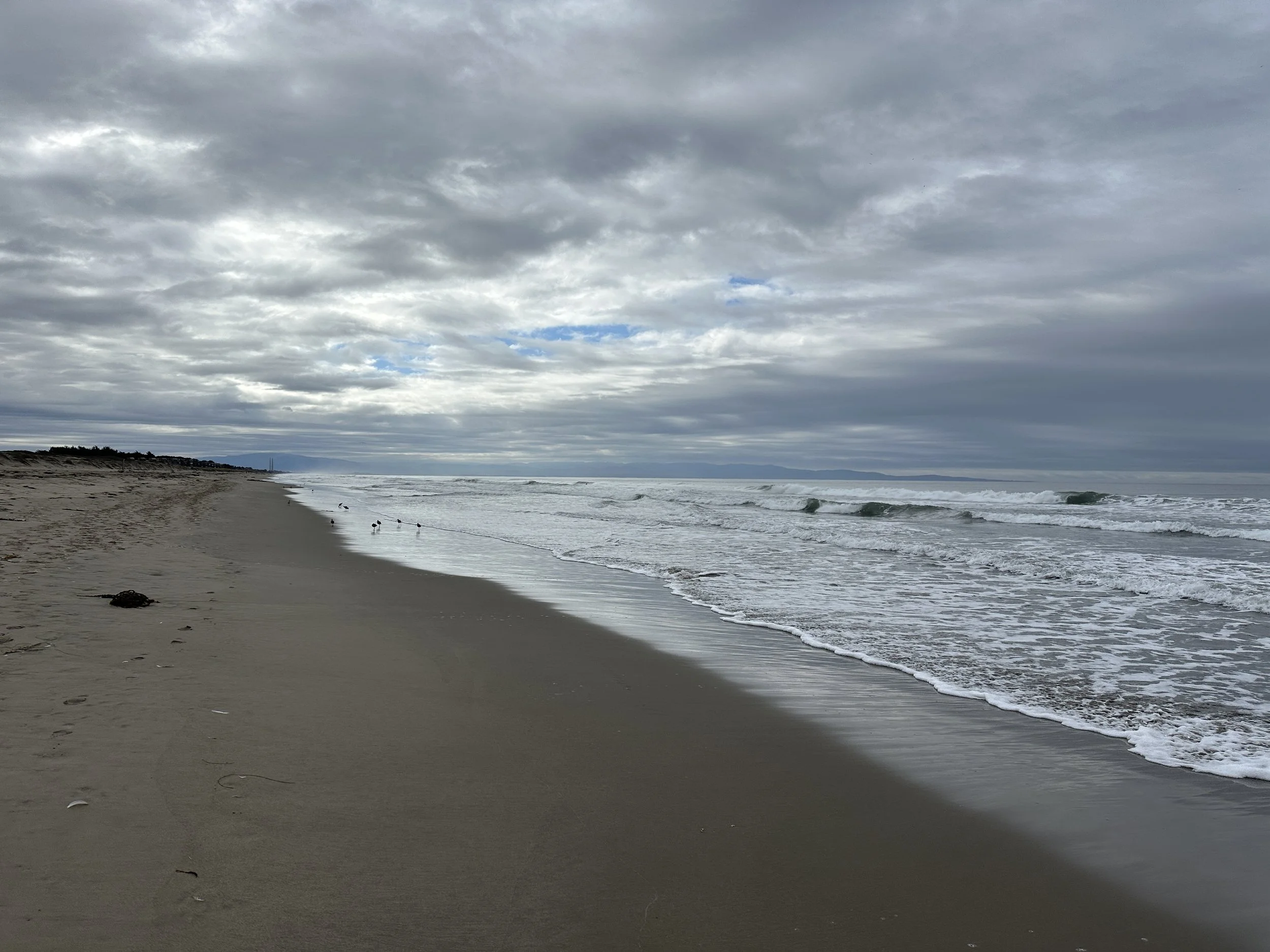
There’s a particular stretch of coastline here in the Monterey Bay that feels like my own secret world. It’s not hidden, exactly, it’s just a bit of a walk. And that walk makes all the difference.
Sunset State Beach, nestled between the Moss Landing stacks to the south and Manresa Beach to the north, holds a kind of hush that I crave. Most visitors stop at the access points, but if you’re willing to wander, the crowds thin, the noise drops, and something exquisite begins to emerge: space. Spaciousness in the body, in the breath, in the mind.
This is where I come to reset.
Maybe three mornings a week, I make the drive with a thermos of tea and no particular agenda other than to arrive, to this moment, to myself, to the horizon. Often, there’s no one else in sight. Just pelicans slicing through the sky, sometimes dozens at once, and the rhythmic hush of the Pacific rolling in.
Barefoot grounding is non-negotiable. I step onto the sand and let it wake up my feet, recalibrate my spine, return me to something ancient and alive. I pick things up, driftwood, feathers, seaweed tendrils, anything that calls. It’s a simple way to let my body remember that it belongs here.
I’ve painted many of my Monterey Bay-inspired pieces from this stretch, not always directly, but energetically. The pelicans, the long sweeping lines of ocean, the soft hazy light that kisses the dunes, it’s all encoded. This place breathes into my work. And I breathe better because of it.
There’s also something scientific beneath the soulfulness. The Earth’s Schumann Resonance, its subtle electromagnetic pulse, has been shown to align with and soothe the human nervous system. It’s measurable. But I don’t need a study to tell me what I already feel: after just 15 minutes with my toes in this sand, I’m different.
And then there’s the horizon. I make myself look at it, eyes lifted, scanning the blue edge where ocean meets sky. Neuroscience tells us that lifting our gaze, especially to long vistas, reduces our sense of threat and opens the parasympathetic pathways of calm. I feel that truth in my body. Every time.
So while I love my studio, and my podcast mic, and the daily work of art and voice, this, this quiet stretch, is the ritual that holds it all together. It’s where I remember who I am when the algorithms, inboxes, and invoices start to blur the edges.
And I suppose I’m sharing this not because it’s for sale, but because it’s real. And maybe you have a place like this, too, or maybe you’re looking for one. A place that doesn’t need to impress anyone. A stretch of sand where you get to just… be.
Here’s to the quiet ones.
The long walks.
The recalibration.
And the return.
Lisa
The Inspire Easel That Became Part of My Rhythm: My New Collab with KraftGeek
I don’t usually gush about gear.
But this easel?
I genuinely love it.
It’s become part of my creative flow,
from studio mornings to plein air afternoons,
from quick sketches on the patio
to full palette-knife sessions at the beach.
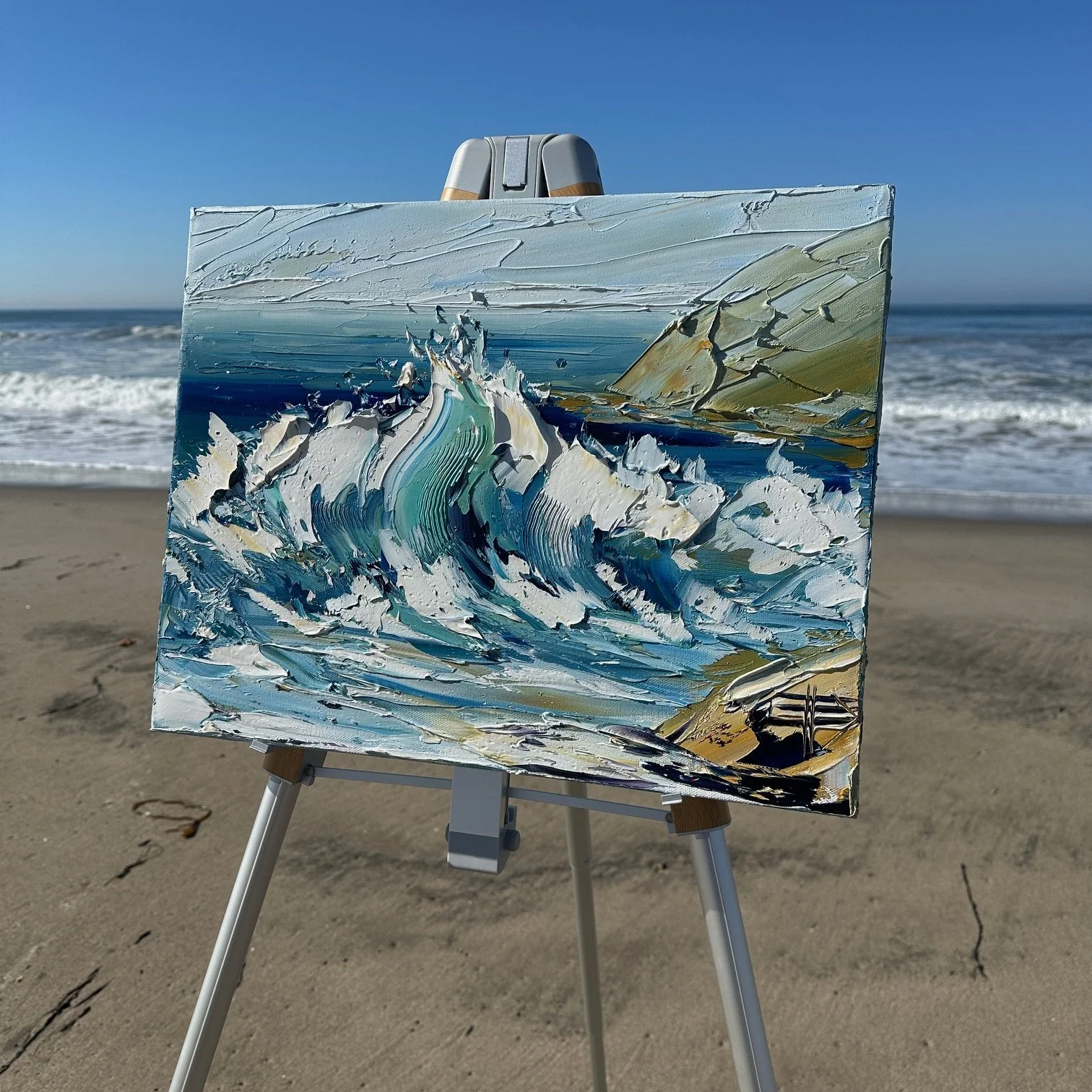
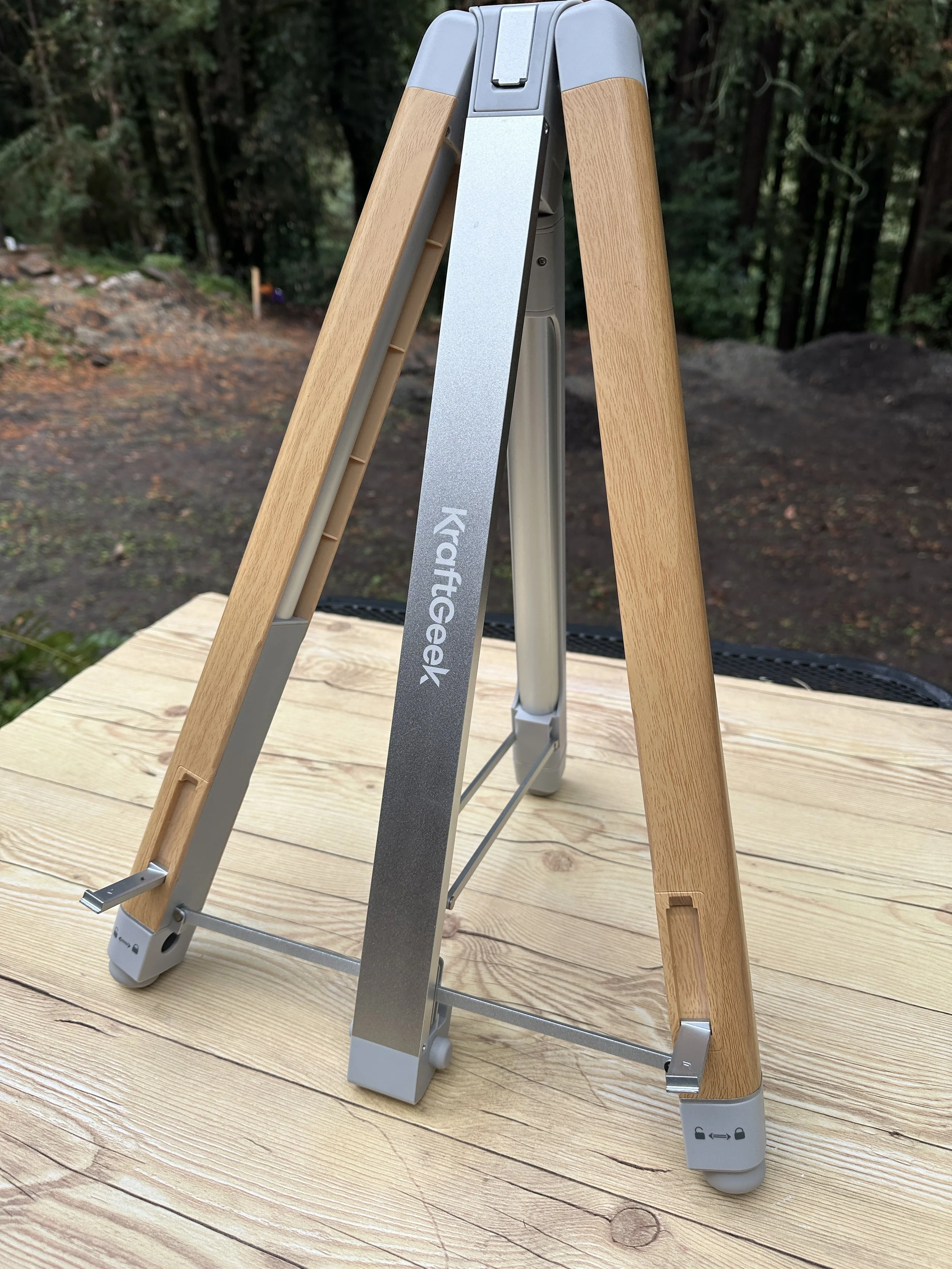
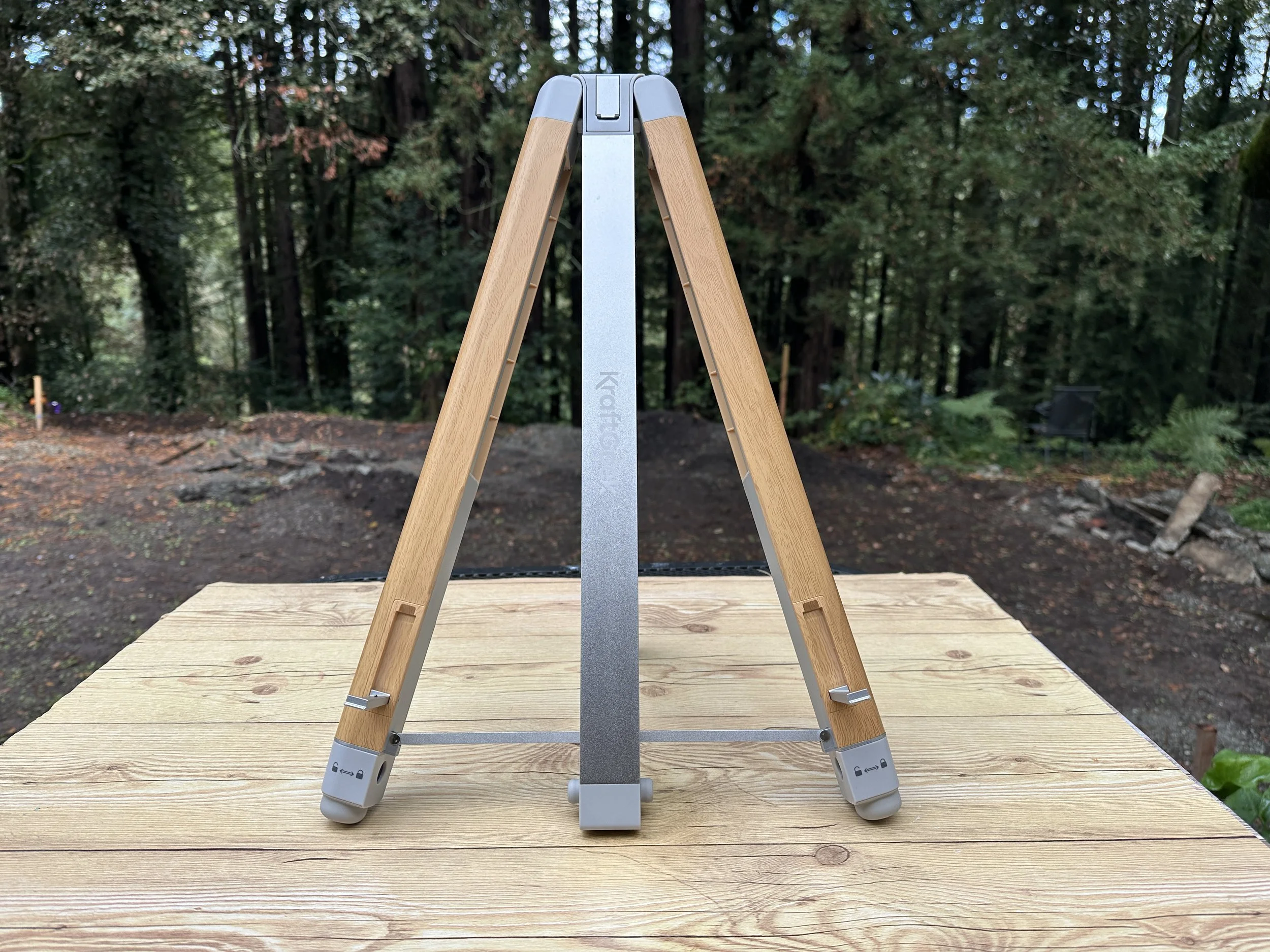
The KraftGeek Inspire Easel is light, sleek, and folds up like origami.
No clunky cases. No complicated setup.
Just effortless creativity, wherever the inspiration lands.
I’ve painted for years on a wide range of easels, heavy wooden studio beasts, classic French styles, and everything in between. But none of them moved with me like this one does. This one feels… alive. Designed with the working artist in mind. Thoughtful. Modern. Functional. And beautiful.
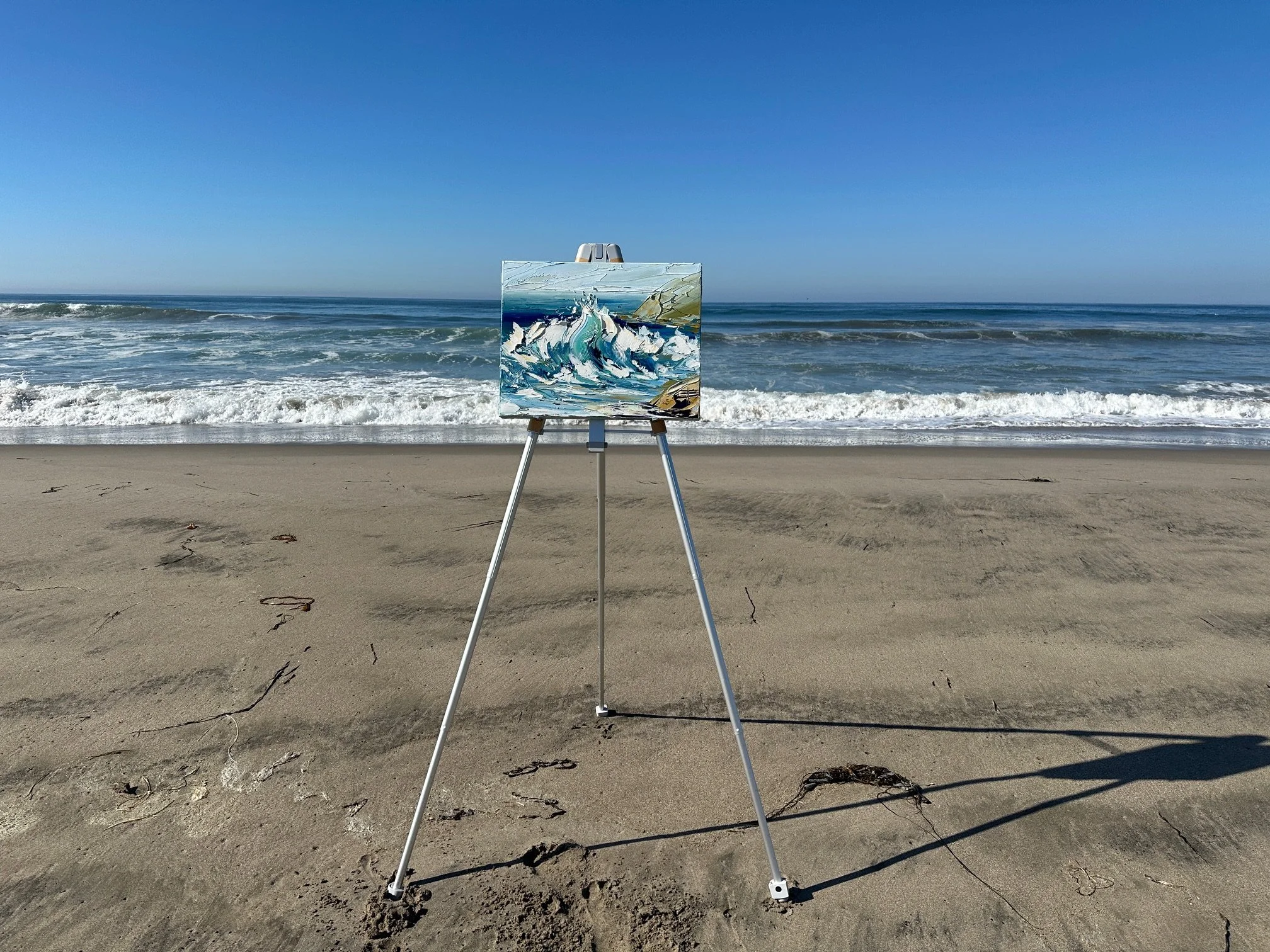
Here’s what I love most:
Portable & Convenient
Whether you’re working in a small studio or out on the cliffs, this easel travels light. No extra bag required, just fold, sling, go. I’ve taken it from trail to trunk to table without missing a beat.
Adjustable & Versatile
It adjusts up to 65” tall and works just as well on uneven ground as it does in a calm studio corner. From quick studies to larger pieces, the setup flexes to your flow.
Canvas-Friendly
With its expandable spring holder, it easily fits most of my canvas sizes, especially my signature 11x14s, 16x20s, and beyond. It holds everything steady, even with my thick impasto textures and bold palette-knife gestures.
Weather & Studio Ready
Rain mist? Beach sand? Paint splatters? No problem. It’s stain and water resistant, which makes it a dream for outdoor use and daily studio life. Durable enough to live in your car if needed. (Ask me how I know.)
🔧
Smart Details
There’s a 1/4’’ screw mount for lights or cameras (great for time-lapse captures), and even a hook for your bag or rag, no more scrambling for dropped brushes or balancing your gear on a rock.
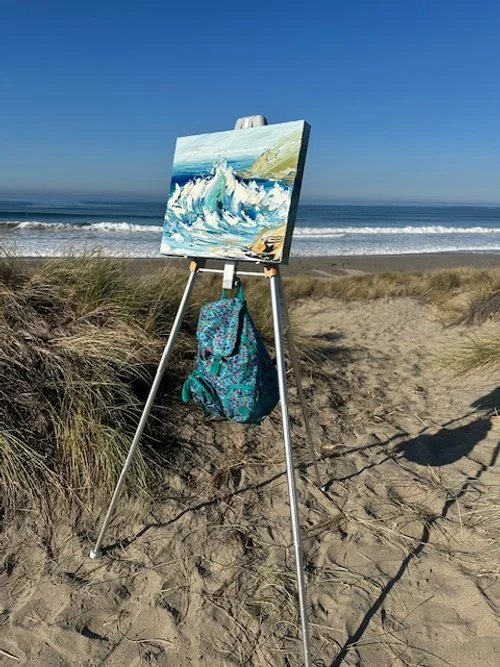
If you’re an artist who loves mobility, simplicity, and gear that disappears into your rhythm, this is the one.
🧡 I’ve partnered with KraftGeek to offer you 15% off
Use code: lisa15 at checkout
✨ Shop here: KraftGeek Online Store
✨ Or via Amazon US
Here’s to making beauty wherever you are
with tools that carry the weight,
so your art can stay light.
Lisa
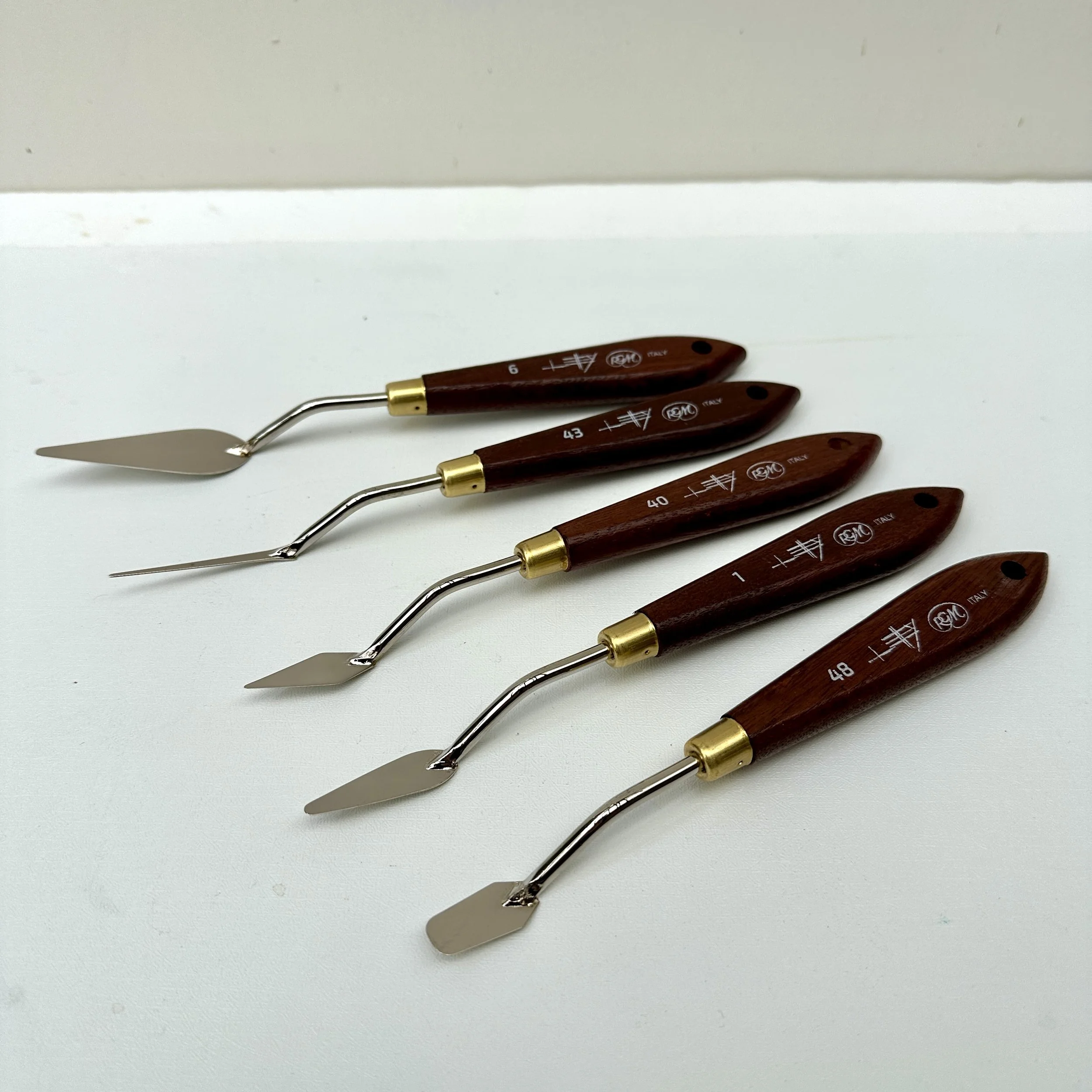
The Arrival of the Lisa Elley × RGM Palette Knife Collection
There’s something sacred about the tools we hold in our hands, the ones that translate vision into texture, thought into form, and feeling into paint. For me, palette knives have always been more than instruments of craft; they are conduits of movement, freedom, and the language of light.
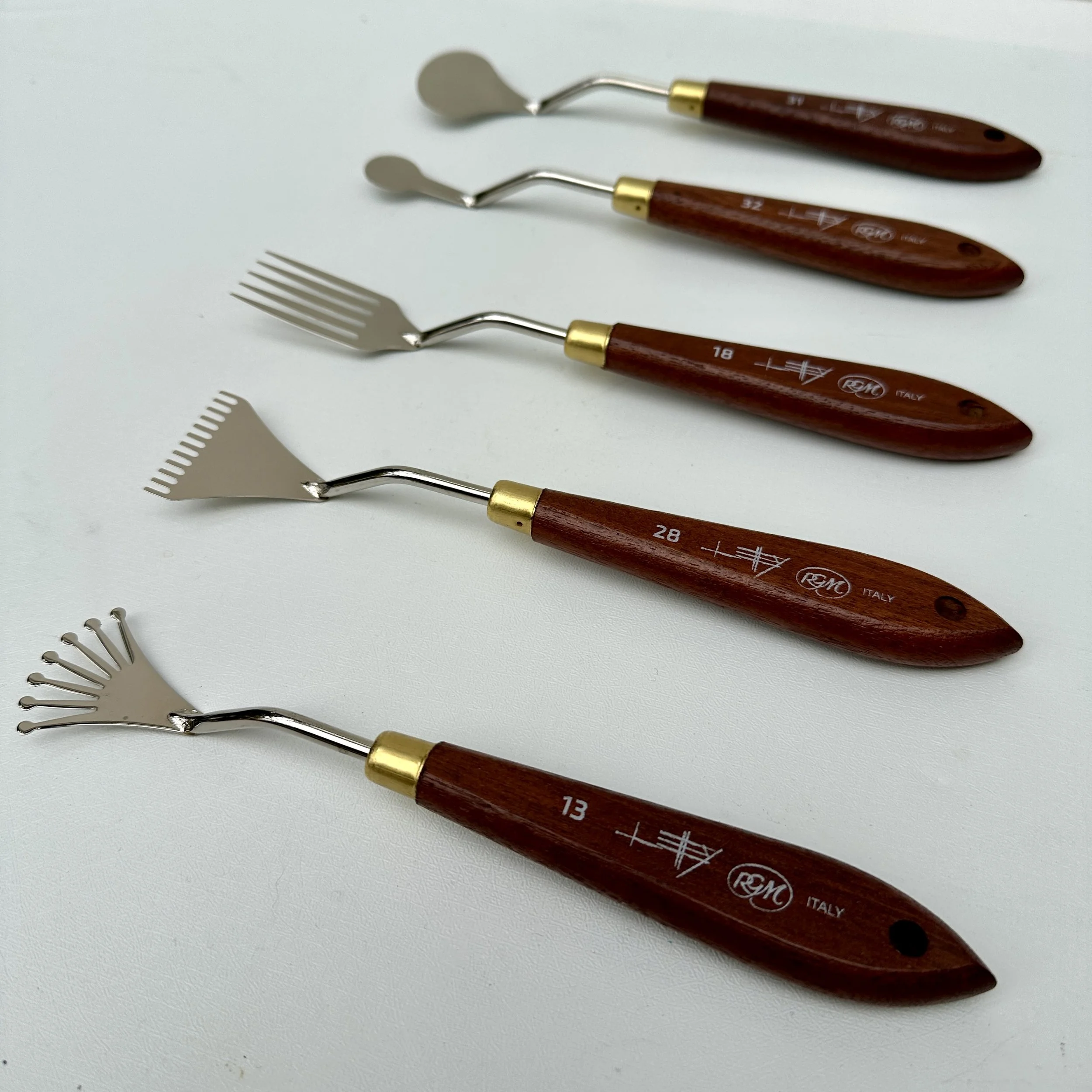
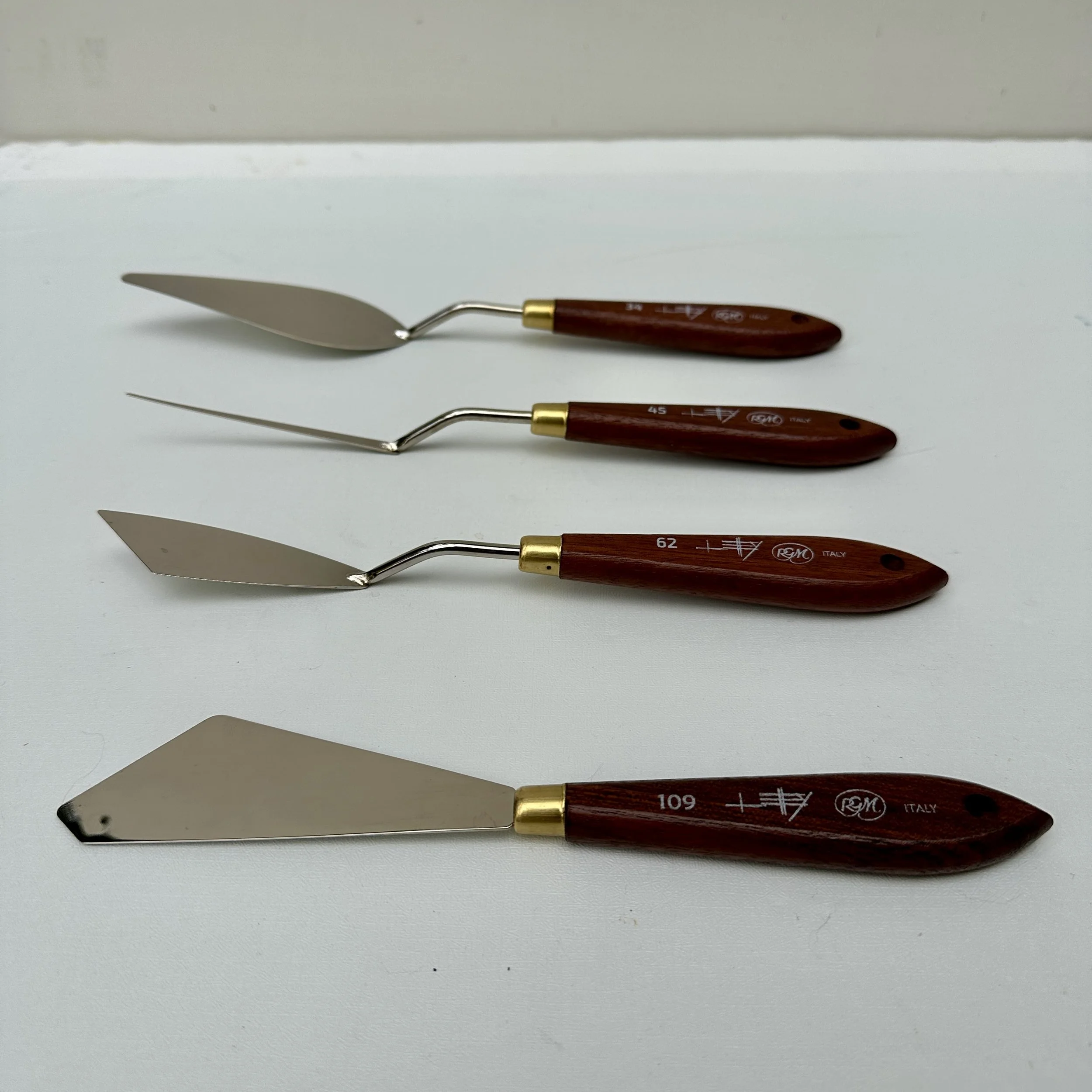
I’m thrilled to share that my limited edition Lisa Elley × RGM palette knife sets are now available on my site, a collaboration grounded in beauty, heritage, and timeless craftsmanship.
Three Curated Sets
Each collection was designed for a distinct kind of artist, from the studio explorer to the seasoned painter:
🌿 The Studio Set: Five versatile knives for daily use and fluid expression.
🌸 The Grande Set: Four larger knives built for bold, sculptural impasto and expansive canvases.
🌺 The Floral Collector Set: Five specialty knives with unique blade shapes, inspired by the organic curves and petals I so often paint.
Italian Craftsmanship & Artistic Lineage
Each knife is crafted in Italy by RGM, a company whose legacy of precision and artistry spans generations. Their tools are used by artists around the world who understand that the right knife isn’t just a tool, it’s a lineage of mastery.
These knives carry that lineage: beautifully balanced, elegantly designed, and ready to become part of your own creative story.
Limited Edition
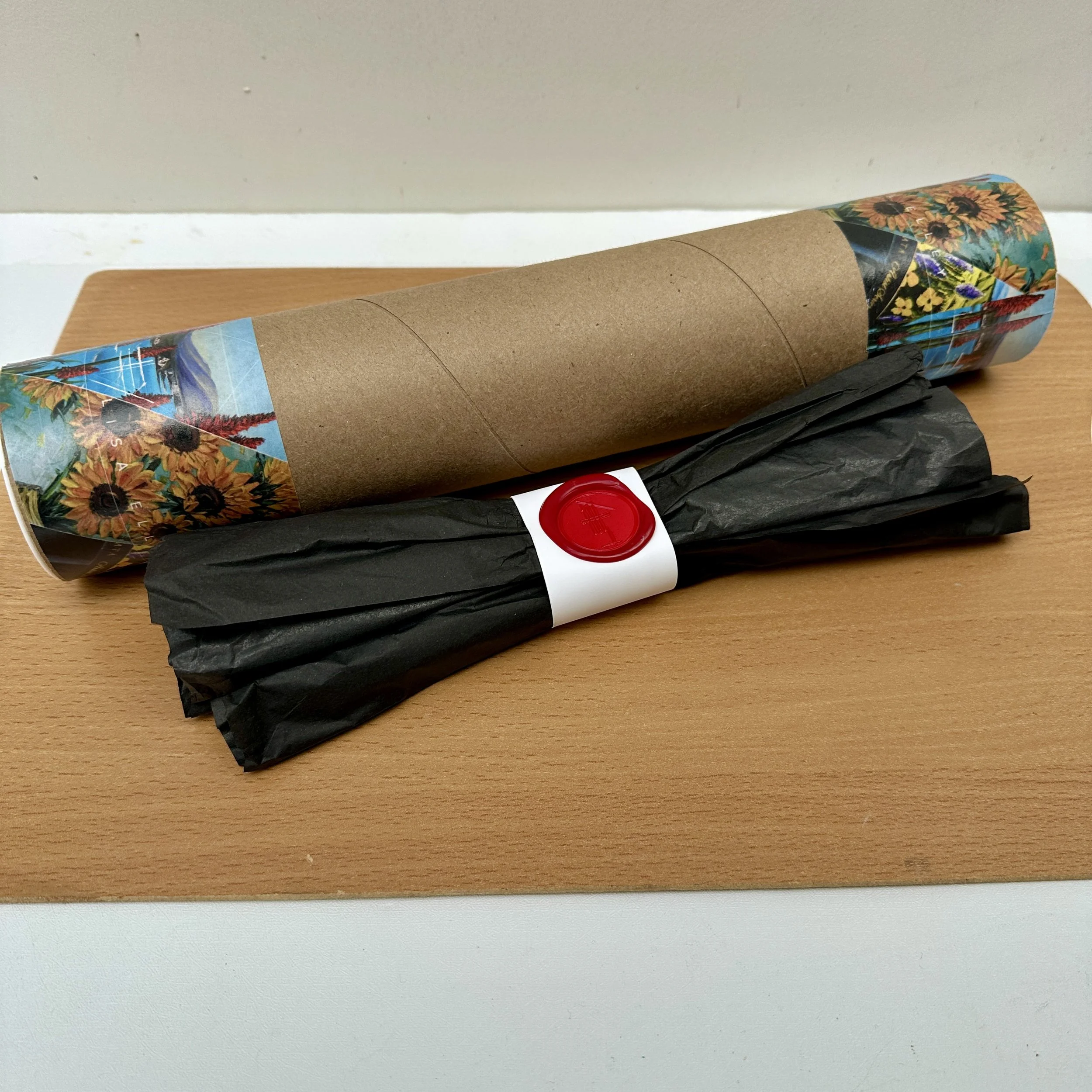
This collaboration is deeply limited. Once these sets are gone, they won’t return in this exact form. Each set arrives beautifully packaged, a keepsake as much as a working tool, designed to honor the craft of painting itself.
To everyone who’s already ordered, thank you. Your support means the world.
Announcing My Collaboration with Fracture: My Art, Now on Glass
I’m so excited to finally share this…
A new way to experience my work has arrived, and it’s absolutely stunning.
I’ve partnered with Fracture, a company I genuinely admire, to offer select pieces of my art as frameless glass prints, a modern, sleek, and luminous way to bring fine art into your space.
And it’s not just the result that’s beautiful.
The process behind each Fracture print is something truly special.
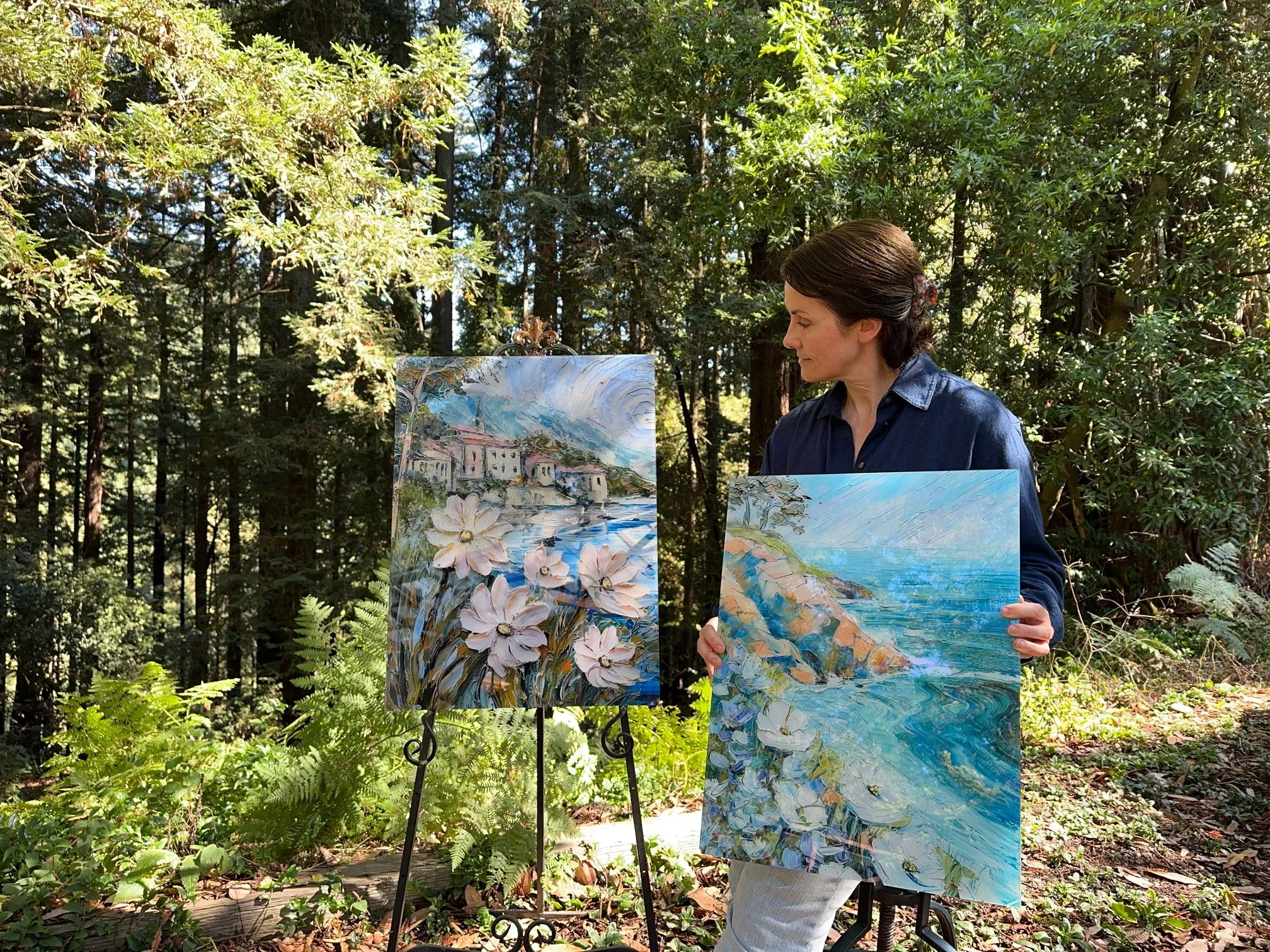
Fracture X Lisa Elley
From Canvas to Glass: A New Chapter
Before it ever hangs on your wall, every Fracture print begins as a piece of durable glass, hand-prepared and precision-cut to size.
It’s not printed on glass, it’s printed directly onto it.
Here’s how it all comes together:
COLOR INK
Rich, vibrant ink is sprayed directly onto the glass, not paper or canvas, and cured instantly using UV light.
This process locks in the brilliance, ensuring the colors pop and stay vivid for decades.WHITE INK BASE
Beneath that color is a bright layer of opaque white ink. This base gives the art its signature depth and clarity, allowing even the most subtle texture and hue shifts to shine through.FLOAT MOUNT BACKING
Finally, a clean, lightweight mount is attached behind the glass so the piece floats slightly off your wall, minimal, elegant, and strong.
Why I Love This Format
I’m so intentional with how I create, and it means everything to me to partner with people who care as much about the final experience as I do.
Fracture’s process is:
Sustainable & carbon neutral
UV-proof and long-lasting
Proudly made in the USA
Hand-checked by real humans before shipping
All of their prints are assembled and shipped from their workshop in Alachua, Florida, and every order goes through a rigorous visual inspection before it leaves.
It’s a truly thoughtful approach, and you can feel the difference when you hold it.
Now Available: My Work on Fracture
A curated collection of my pieces is now live on their site, printed on sleek glass, ready to elevate your space with bold, modern clarity.
Whether you’ve been collecting my work for years or are just discovering it, this new format offers a beautiful, accessible way to bring my paintings into your home.
🖼️ Click here to view my exclusive collection with Fracture
I can’t wait for you to see it!
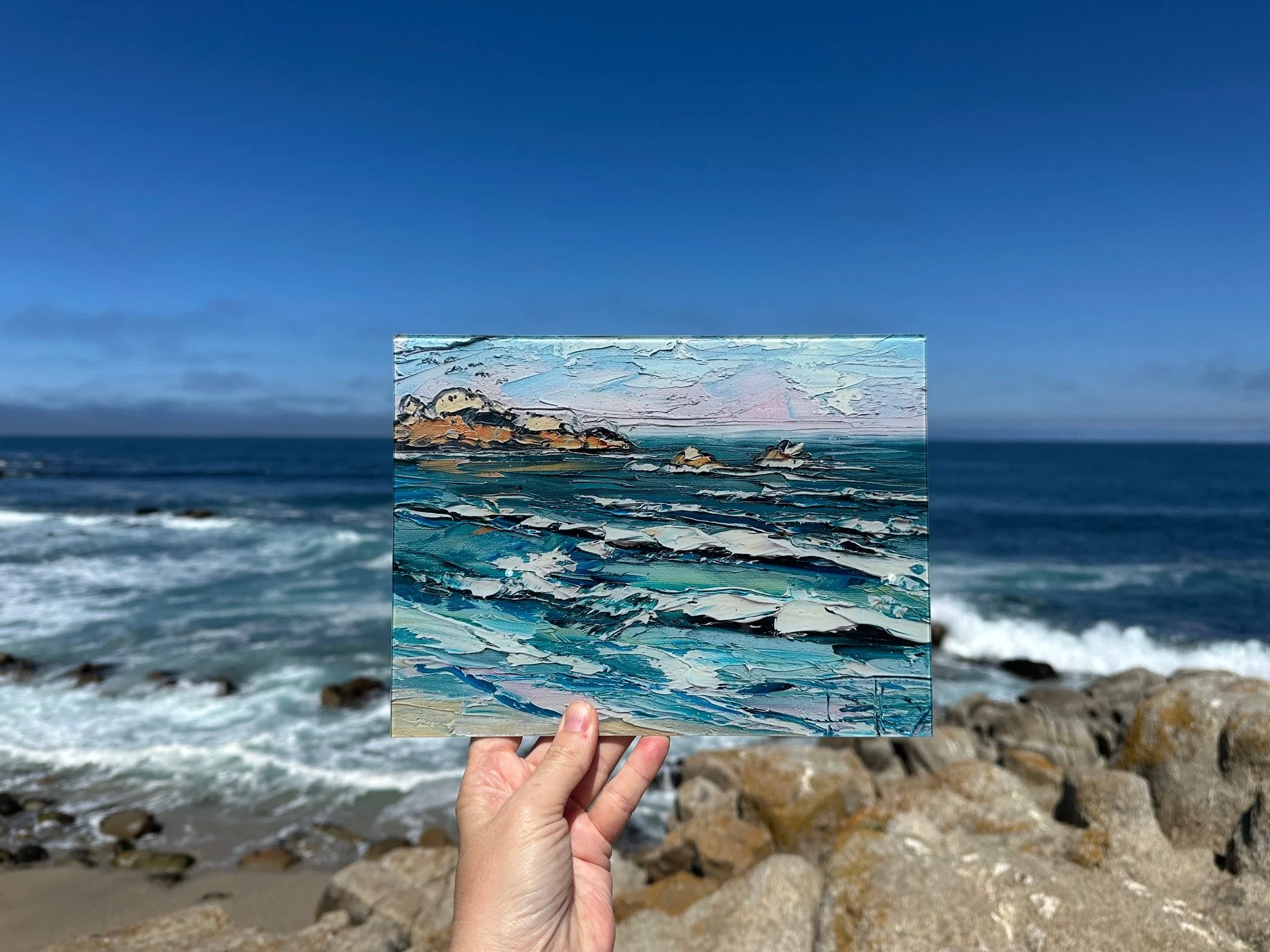
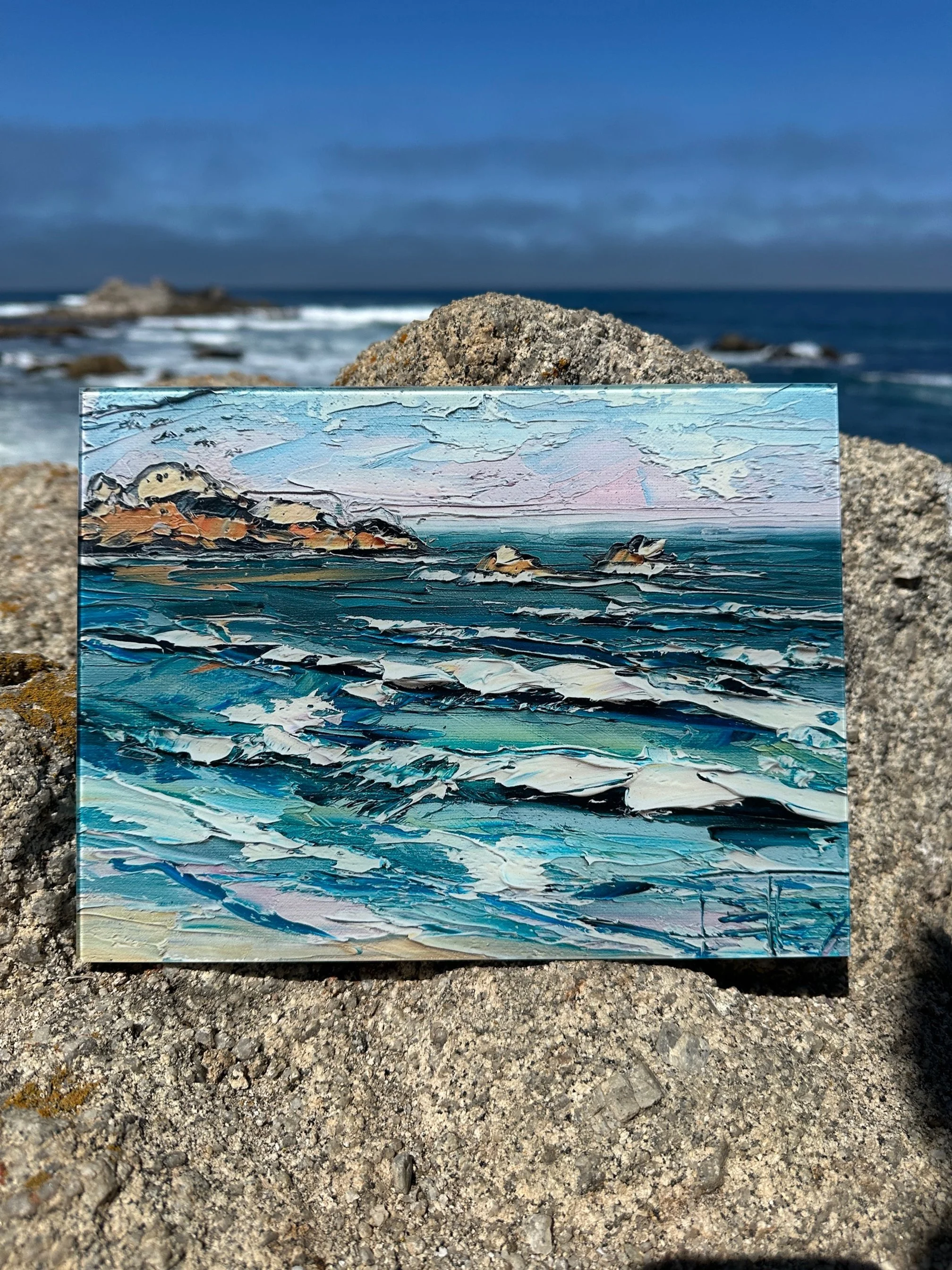
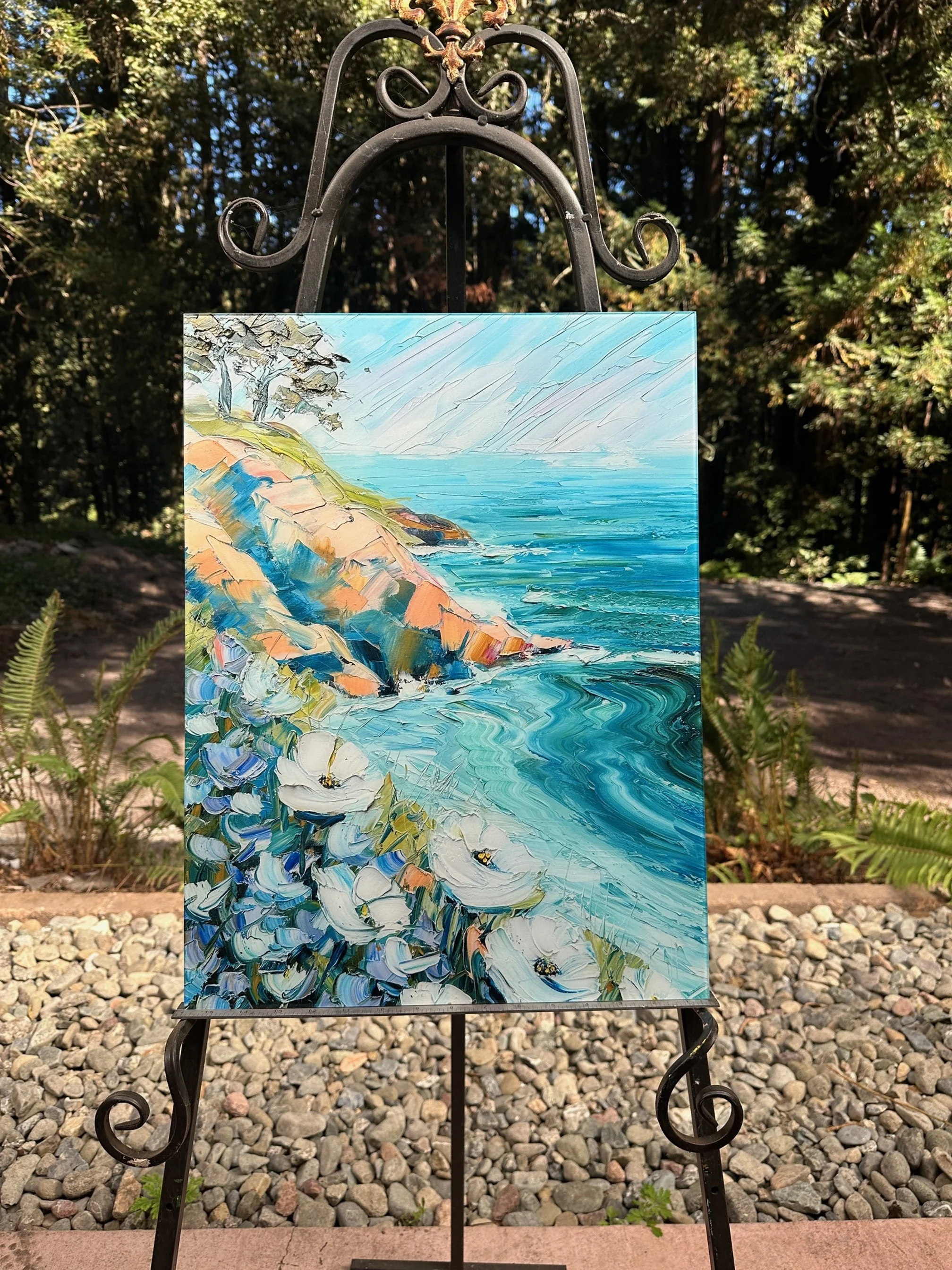
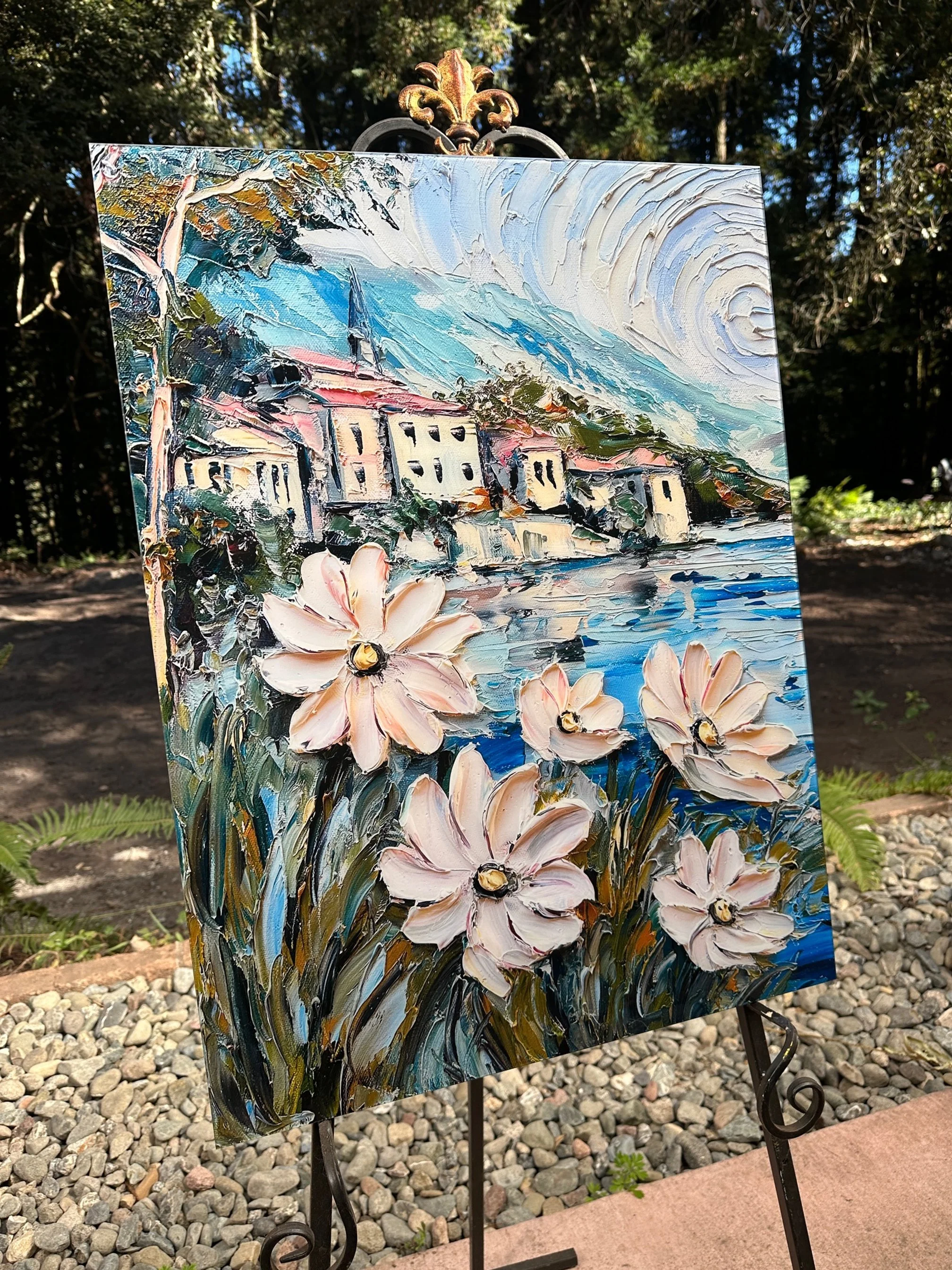
Oceanlight Reverie: A Portal of Poppies and Sea
There’s a certain kind of morning light along the California coast, the kind that blurs the line between land and water, color and feeling. Oceanlight Reverie was born from that light.
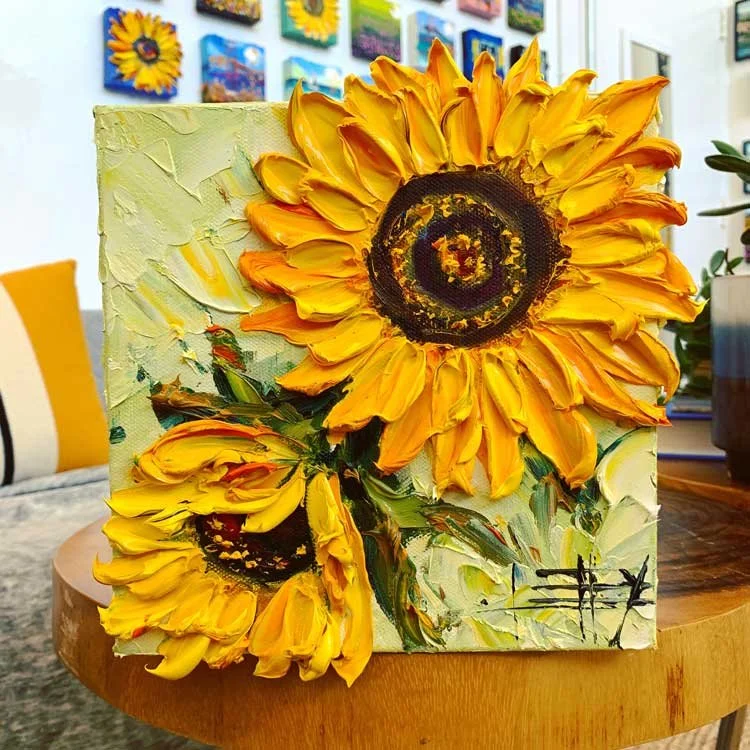
This 10x10” original oil painting came to life in the studio with my trusted RGM palette knives, no brushes, just movement, texture, and presence. Thick impasto layers catch the sun like wet petals, while waves of aqua and cerulean whisper of spring poppies blooming by the sea.
But more than a scene, this piece is a frequency.
I don’t paint to replicate a view. I paint to encode a moment, a breath of aliveness, a portal to coherence, a little square window into what it feels like to belong to the world again.
Oceanlight Reverie is part of a new unfolding, one-of-a-kind originals released in real time, while the paint is still fresh, and the transmission still humming.
If it calls to you, you’ll know.
🖼 Painting Details:
• 10x10” oil on gallery-wrapped canvas
• Edges painted, ready to hang
• Created with RGM knives only, no brushes
• Ships immediately
• Signed front and back
• Certificate of Authenticity included
🎨 Available now → https://windsweptstudio.com/shop-f8A7B/p/oceanlight-reverie
Thank you for being here, witnessing the work as it arrives.
With texture, color, and light
Lisa